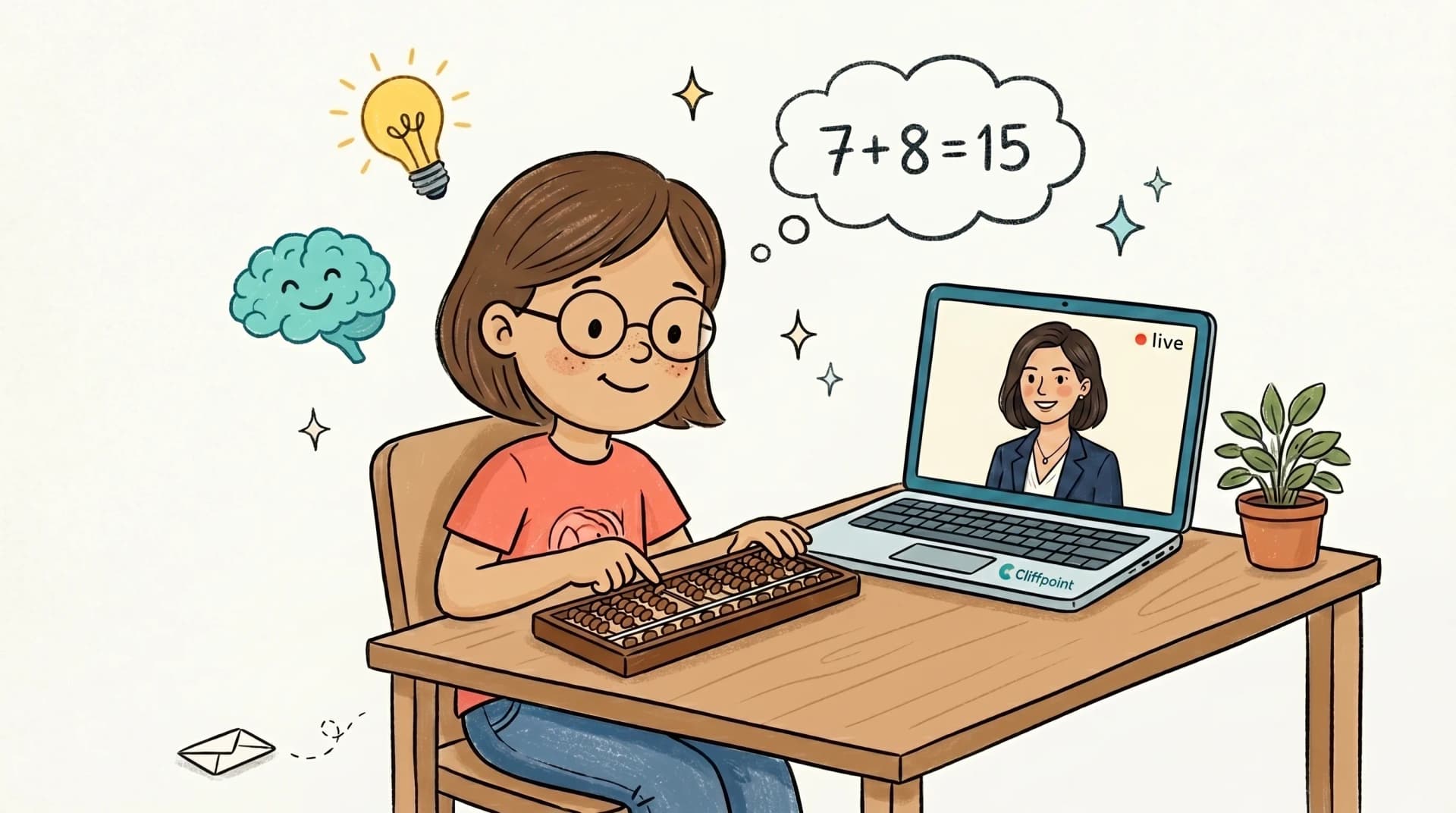
Australian families are turning to online abacus classes as a research-backed tool for building maths confidence from primary school onward, flexible enough to fit around school schedules in any time zone.
A common question we hear from parents is about the timeline: how long does learning the abacus actually take, and what does the journey look like?
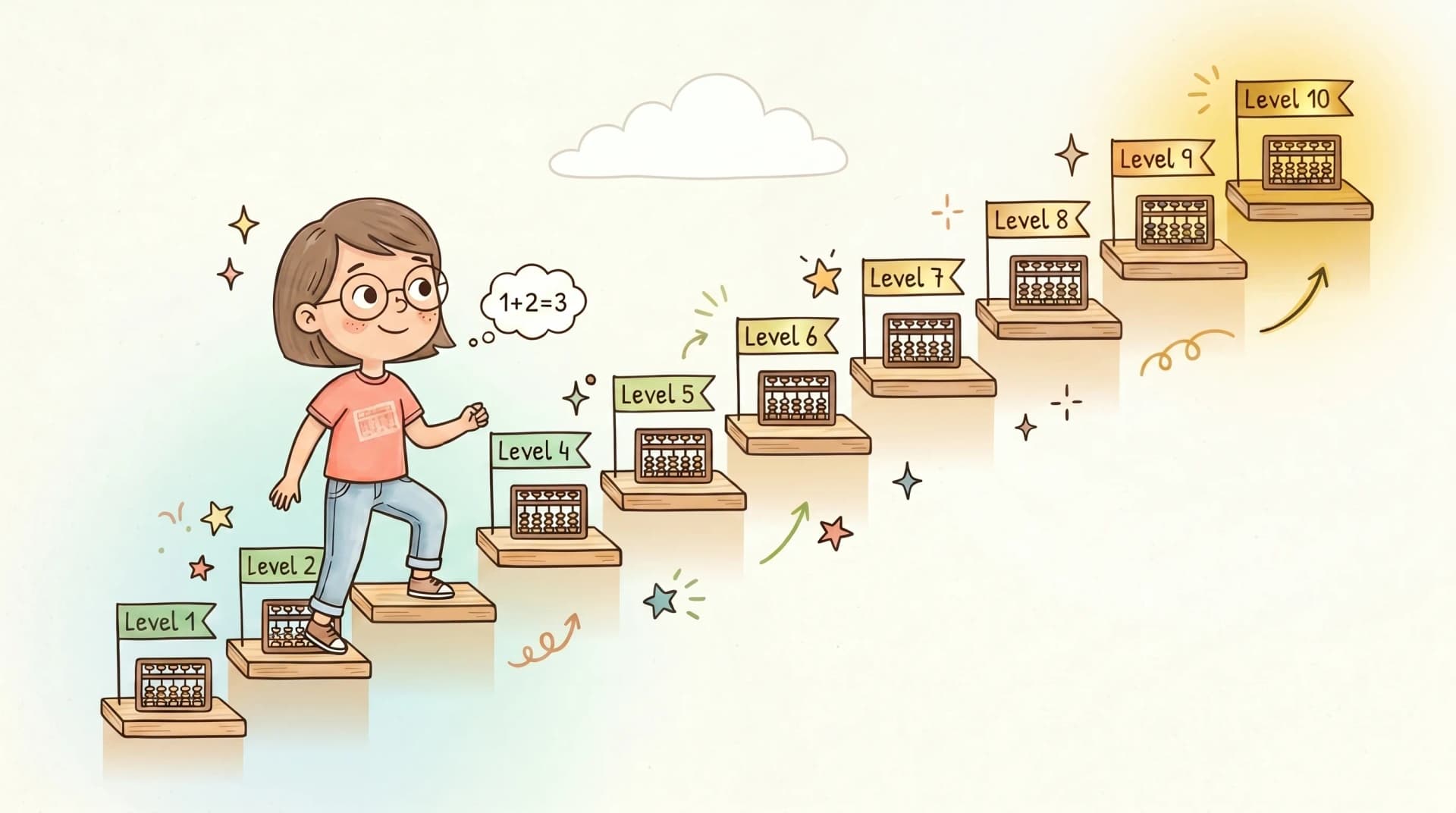
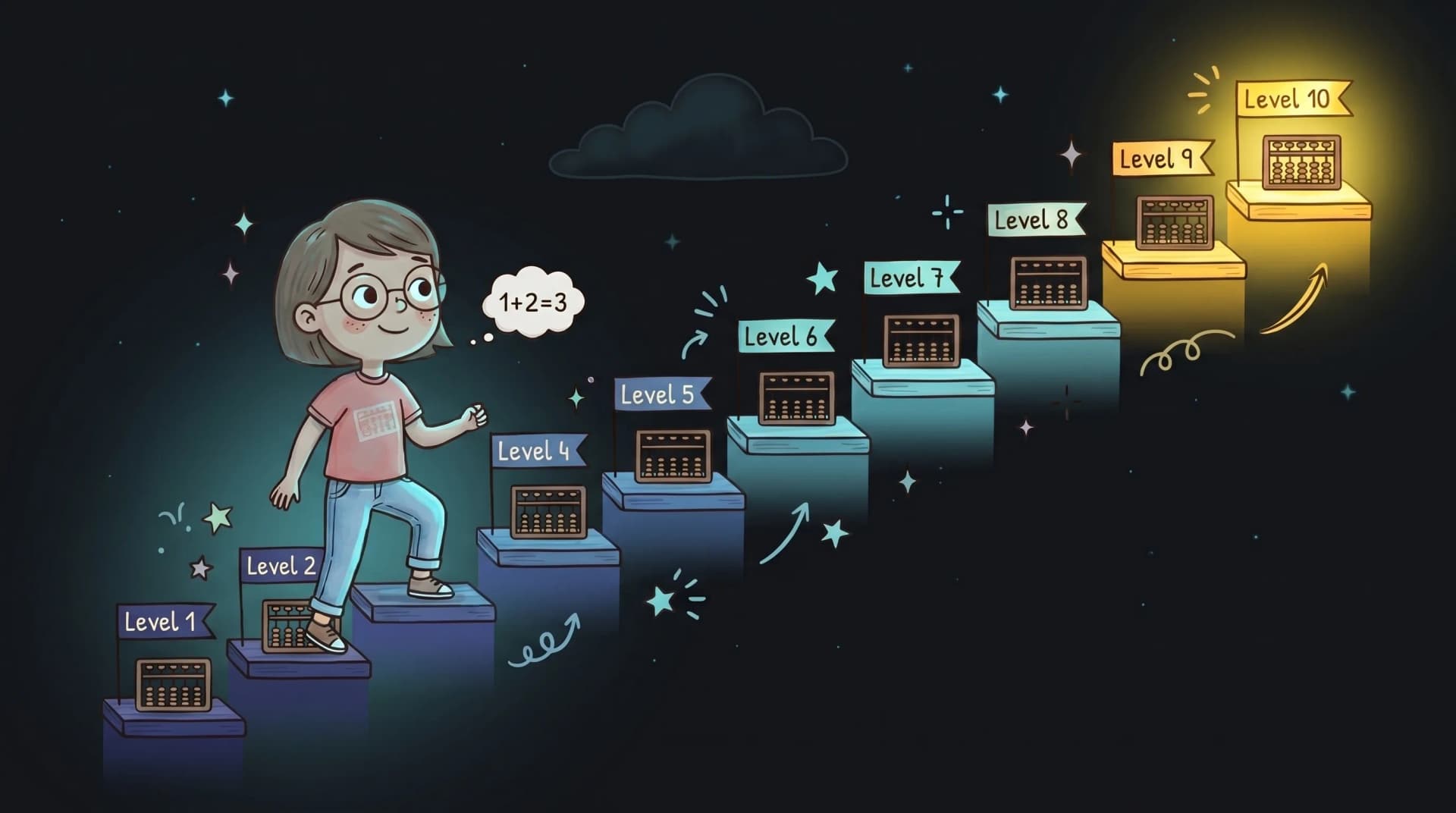
Generally, the full program takes two to three years and is divided into ten levels. Each level requires about three months of consistent practice. By the end of the journey, students can solve complex addition, subtraction, multiplication, and division problems entirely in their heads.
This article breaks down each of the ten levels, explaining what kids learn at every stage, the milestones to watch for, and how parents can track their progress.
How abacus levels work
Most reputable academies use a 10-level progression inspired by the Japanese soroban kyu grading system. Each level typically takes three to three and a half months to complete when practicing twice a week. The skills are cumulative, meaning techniques learned early on are continually reinforced.
Students advance based on written and oral assessments rather than simply time spent in class. This ensures they have truly mastered the material before moving forward. There is no penalty for needing extra time, as the primary goal is always mastery over speed.
The 10 levels at a glance
Here is a quick overview of the complete progression:
- Level 1: Bead introduction, single and double-digit addition, and the first formulas
- Level 2: Double-digit work and the start of multiplication
- Level 3: Three-digit addition and subtraction, multiplication, and the start of division
- Level 4: Four-digit addition and subtraction, double-digit multiplication, three-digit division
- Level 5: Three-digit mental arithmetic and basic multiplication
- Level 6: Multiplication mastery and basic division
- Level 7: Multi-digit multiplication and division
- Level 8: Decimals and fractions
- Level 9: Advanced mental math
- Level 10: Master level and competition speed
Level 1: Bead introduction, addition, and the first formulas
This is the starting point. Children learn the anatomy of the soroban and the correct thumb-and-index-finger technique for moving beads. They cover single-digit and double-digit addition, and meet the first abacus formulas that teach them how to handle adjustments when a column runs out of beads.
By the end of the level, a typical problem like 34 + 27 = 61 can be done on the abacus with confidence.
Level 2: Double-digit work and the start of multiplication
Students build comfort with double-digit addition and subtraction, then meet multiplication on the abacus for the first time.
A sample problem at this stage is 23 × 4 = 92 on the abacus.
Level 3: Three-digit operations and the start of division
Three-digit addition and subtraction become routine. Multiplication continues to grow, and division is introduced for the first time.
A typical problem at this stage is 245 + 367 − 128 = 484, alongside simple division.
Level 4: Four-digit operations and three-digit division
The digit count keeps growing. Children handle four-digit addition and subtraction, double-digit multiplication, and three-digit division on the abacus.
A typical problem is 4,256 + 3,178 = 7,434, alongside multiplications like 47 × 35 and divisions like 624 ÷ 8.
Level 5: Three-digit mental arithmetic and basic multiplication
Mental arithmetic expands to three-digit numbers, which significantly improves working memory. Students are also introduced to single-digit multiplication on the abacus, laying the groundwork for the next level.
They can solve 237 + 458 mentally and calculate 23 × 4 on the abacus.
Level 6: Multiplication mastery and basic division
Multiplication becomes the main focus. Students learn to multiply larger numbers on the abacus and tackle simpler multiplication mentally. Division is also introduced at a comfortable pace.
A typical accomplishment is solving 67 × 38 = 2,546 on the abacus.
Level 7: Multi-digit multiplication and division
The skills from Level 6 are expanded to handle larger, more complex problems. Students can now multiply 3-digit numbers and divide 4-digit numbers on the abacus.
They can confidently calculate problems like 462 × 35 = 16,170.
Level 8: Decimals and fractions
The curriculum moves beyond whole numbers. Students learn to perform operations involving decimals up to two places and start converting fractions into decimals.
A sample problem is 34.5 + 12.78 − 5.6 = 41.68.
Level 9: Advanced mental math
At this advanced stage, reliance on the physical abacus is minimal. Students can quickly add multiple 3-digit numbers entirely in their heads. Many can even solve problems simply by listening to them being read aloud.
They can mentally solve a sequence like 145 + 287 − 96 + 124 in under twenty seconds.
Level 10: Master level and competition speed
The final level focuses on speed, accuracy, and refining techniques. Students work on competition-grade problems and practice performing under strict time limits.
Graduates can typically solve complex multi-digit operations in their heads rapidly and sit through timed exams without losing focus.
Common questions about the levels
Can my child skip levels?
No, skipping levels is not recommended. Each stage builds the muscle memory and formula fluency required for the next. Trying to rush ahead usually causes frustration because the foundational skills are missing.
What if my child falls behind?
It is completely normal for a child to need extra time, especially around Levels 4 and 6 when new cognitive skills are introduced. Spending an extra month to consolidate knowledge is much better than rushing. Mastery takes time.
What happens after Level 10?
Some students move on to formal competition training for state or national contests. Others graduate from the program having secured a lifelong mental math ability that will continue to benefit them academically.
Are levels the same across all academies?
Most reputable programs follow a very similar progression, though the exact numbering might vary slightly. A Level 5 in one program might be a Level 4 in another, but the fundamental milestones remain consistent.
What the journey looks like for parents
- Months 1–2: Your child is learning a new physical skill. Expect a learning curve and be sure to offer plenty of encouragement.
- Months 3–6: Confidence grows rapidly. You will likely notice improved focus during homework.
- Months 7–12: This is when the exciting mental math breakthroughs happen, giving children a massive boost in confidence.
- Year 2: Multiplication and division become second nature, and overall math grades often improve.
- Year 3: Students reach mastery level, solidifying their speed and accuracy permanently.
Where to start
The best way to understand the process is to experience the beginning. We offer free 30-minute demo classes that introduce children to the basics of bead manipulation and give parents a clear look at how the program works.
You can also explore our free virtual abacus to try it out yourself, or read our complete guide to the abacus for more background.
Live online batches run across AEST, ACST, and AWST, with weekend morning slots that work for east coast families and weekday afternoon slots that suit Perth. Every new enrolment in Australia starts with a free 30-minute demo class with our certified instructor.