The abacus is one of the oldest calculation tools ever invented. Four thousand years later, it remains a vital educational tool used to teach children mental arithmetic in classrooms all over the world. At its core, the abacus is a simple wooden frame with sliding beads. However, in the hands of a trained child, it becomes a powerful instrument for performing math faster than a calculator.
If you are considering enrolling your child in a program, it is helpful to understand the basics. Here is a breakdown of what an abacus is, how it functions, and why it is still a relevant skill today.
Abacus meaning, in one sentence
An abacus is a manual calculating tool: a frame of rods holding beads that slide up and down, where each rod stands for a place value and the position of the beads on it stands for a digit. You read a number off an abacus the way you read it off a page, one column at a time, and you calculate by moving beads rather than by writing anything down.
That is the whole abacus meaning in plain terms. Everything below is the detail: which beads are worth what, where the tool came from, and why children still learn it long after calculators made it unnecessary for actual accounting.
What is an abacus?
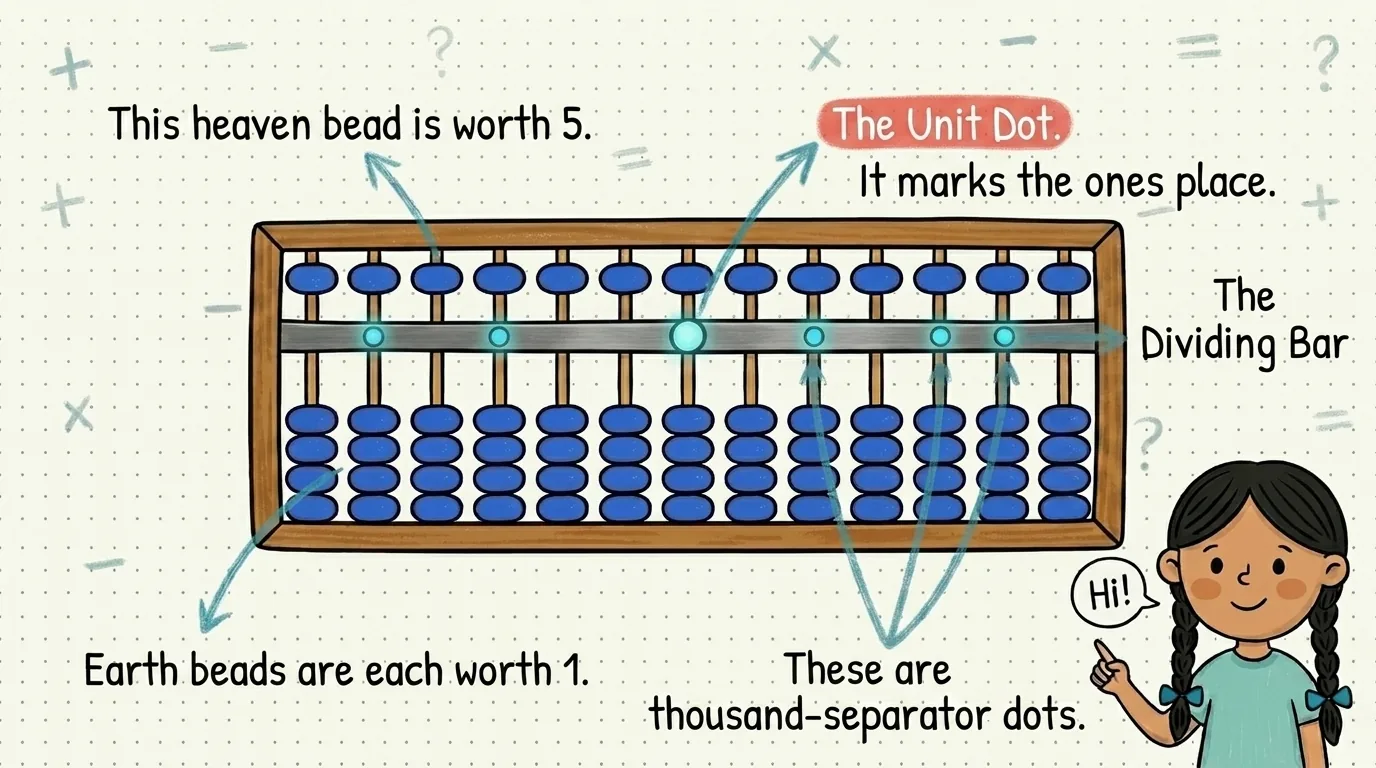
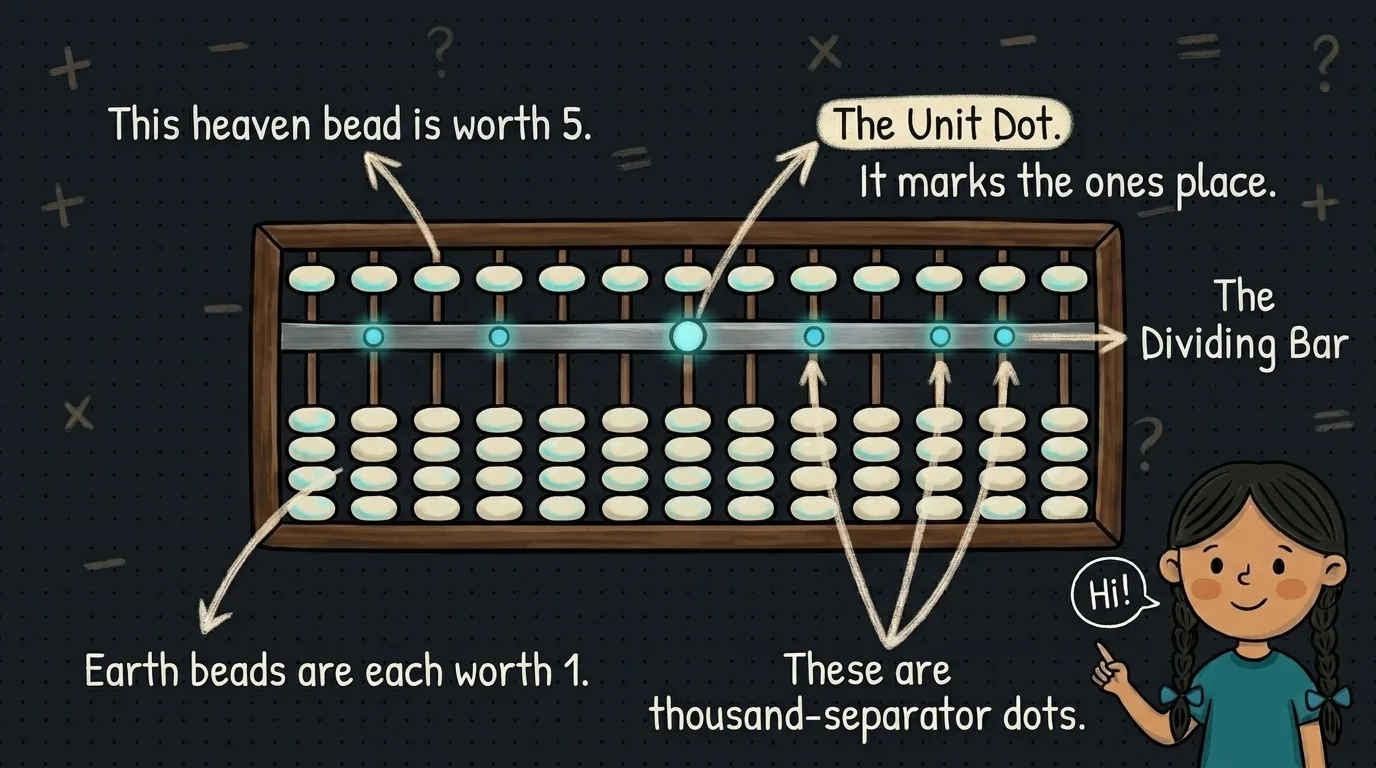
An abacus is a manual calculating tool. The most common modern version is the Japanese soroban. It typically features thirteen vertical columns, with each column holding five beads. There is one bead located above a horizontal dividing bar, known as the heaven bead, and four beads below it, called the earth beads. Each column corresponds to a specific place value. The rightmost column represents the ones, the next is the tens, followed by the hundreds, thousands, and so on.
The true power of the abacus lies in how it encodes numbers. A single heaven bead represents a value of 5, while each of the four earth beads represents a value of 1. By moving these beads toward or away from the dividing bar, you can represent any digit from 0 to 9 in a single column. Once a child internalizes these bead patterns, math becomes an exercise in visual pattern manipulation rather than rote memorization.
A brief history
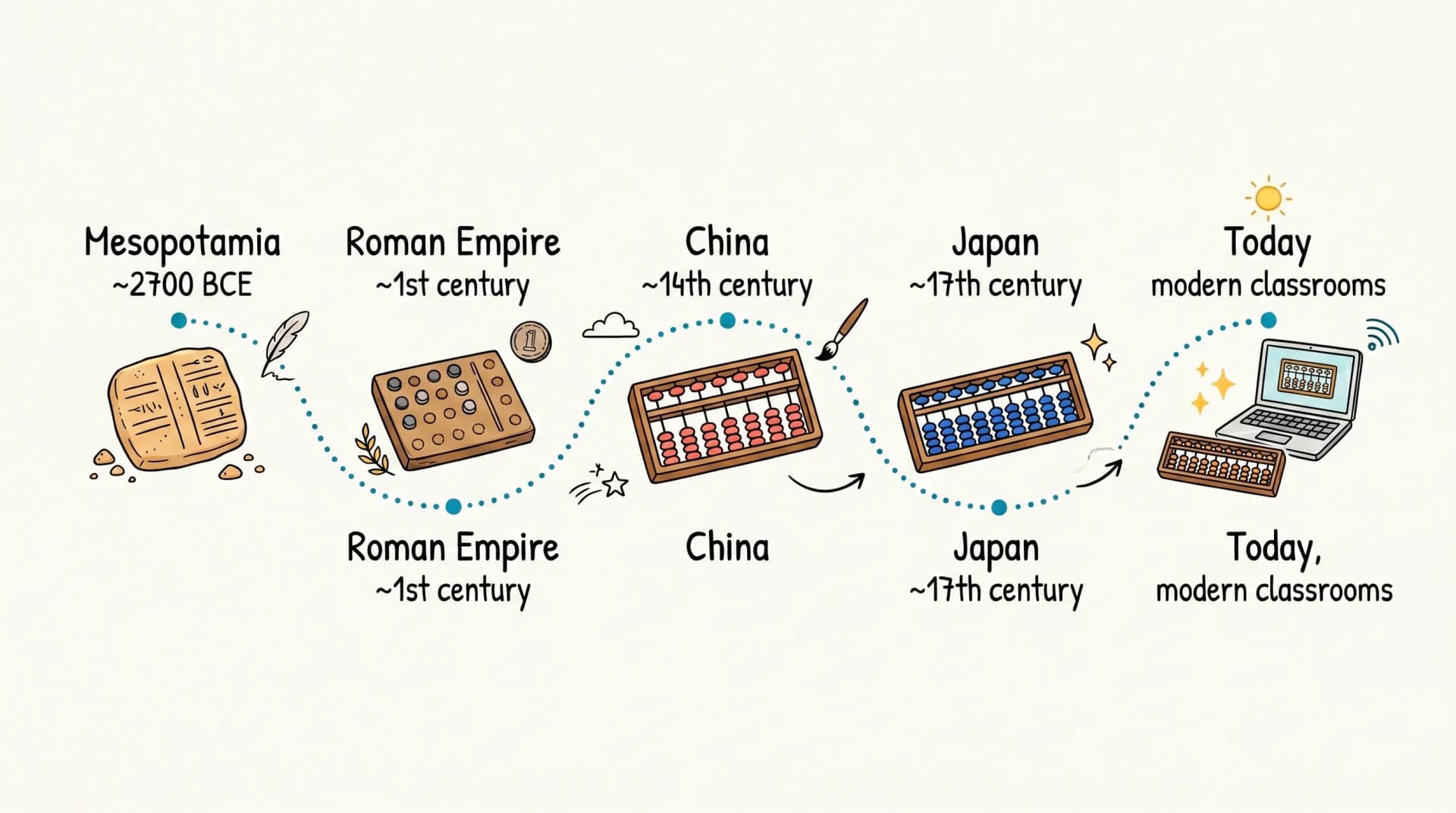
The earliest devices resembling an abacus appeared in Mesopotamia around 2700 BCE as simple sand tablets with grooves used for accounting. Over time, variants of this tool spread throughout Egypt, Greece, and Rome. The Romans used anabacus minor that relied on small pebbles called calculi. This is where we get the modern words calculus and calculate.
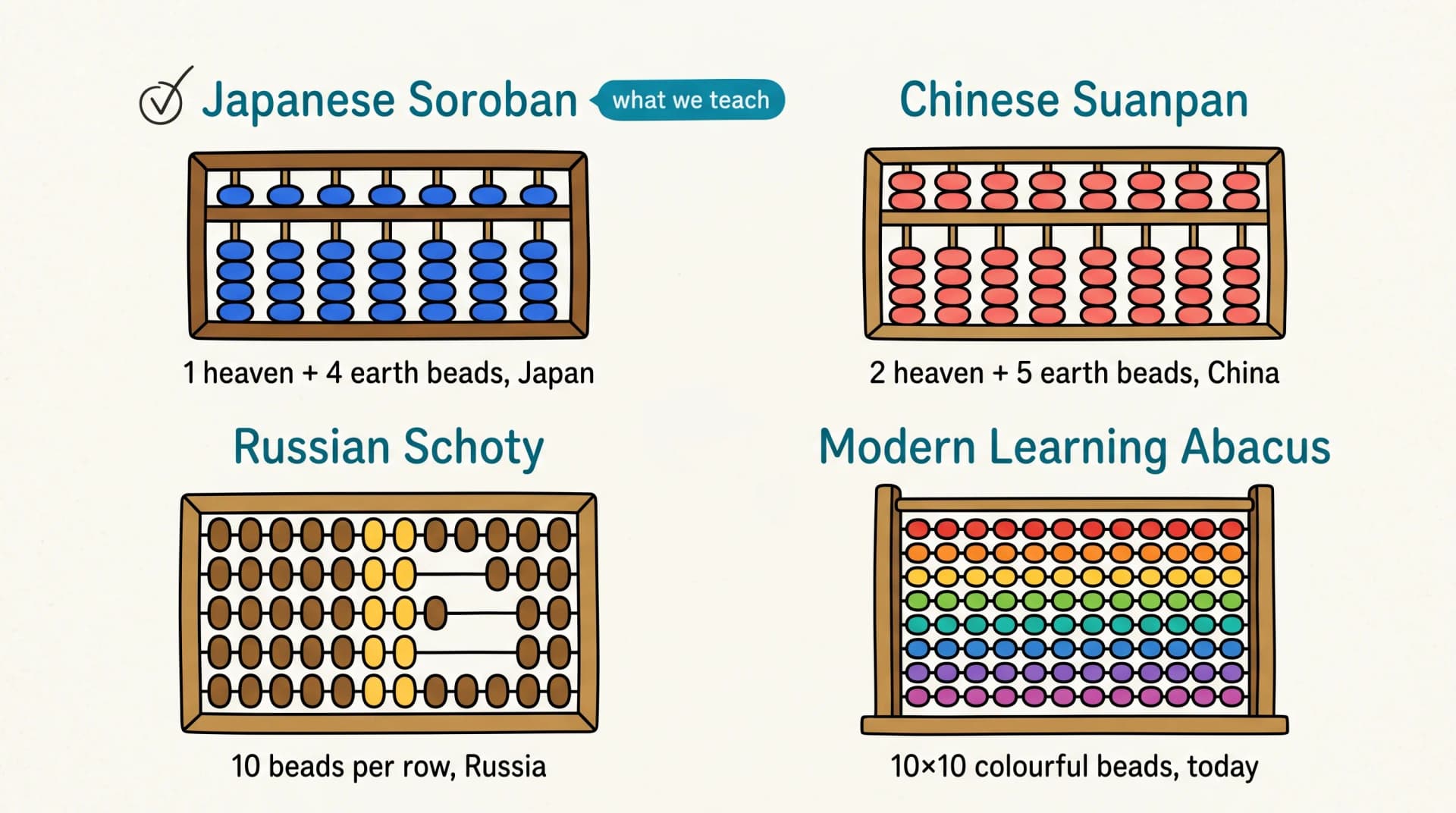
The design we recognize today originated in China around the 14th century. This tool, called thesuanpan, used two beads above the dividing bar and five below. During the 1600s, Japan adapted the Chinese design and simplified it into the modern format we now call the soroban. Around the same time, Russia developed theschoty, a variant featuring ten beads per row and no dividing bar.
For centuries, the abacus was the primary method for calculation. Merchants relied on it for trade, tax collectors used it for accounting, and astronomers used it to map the stars. It was not until the introduction of mechanical adding machines and electronic calculators in the 20th century that the abacus became obsolete for commercial use.
However, its educational value was never lost. By the 1960s, schools in Japan were systematically using the soroban to build mental math skills. Interest spiked globally after a famous 1946 contest in Tokyo, where a skilled soroban operator outperformed an American soldier using an electric calculator in a series of arithmetic challenges. Today, abacus-based mental arithmetic programs teach millions of children worldwide, with strong presence in Asia, the Middle East, the UK, and the US.

What is the abacus full form?
The abacus has no full form. It is not an acronym and the letters do not stand for anything. It is a very old ordinary noun that arrived in English through Latin, which is why the question has no answer to give.
This is worth saying plainly, because a lot of children in India are told otherwise. The word came into English from the Latin abacus, which Latin took from the Ancient Greek ἄβαξ (abax, stem abak-). In Greek it simply meant a slab or a board: a flat surface you could draw on or lay counters on. The Latin sense followed the same idea, covering a slab at the top of a column, a side table, and a counting board.
Beyond Greek the trail goes cold, but the usual suggestion is a Semitic root, often linked to the Hebrew abaq, meaning dust. That fits how the earliest boards were actually used: a flat surface covered in a thin layer of sand or dust, with figures traced in it by finger and wiped away afterwards. Dictionaries mark this last step as probable rather than proven, so treat it as the best available guess rather than settled fact.
So if your child comes home asking what the full form of abacus is, the honest answer is that the premise is wrong and the real story is better: the word means a board covered in dust, which is exactly what people were counting on four thousand years before anyone thought to put beads on rods.
Where the abacus came from
Nobody knows, and almost certainly no single person did. Counting boards appear independently in several ancient civilisations, far enough apart that they cannot all be copies of one original. Any page that names an inventor and a date is inventing the answer.
What we do have is a sequence of surviving objects. The oldest counting board that still exists is the Salamis Tablet, a white marble slab from around 300 BC found on the Greek island of Salamis in the nineteenth century. It is a board with ruled lines and Greek numerals, worked with loose counters rather than fixed beads. The Romans later carried a pocket version, a small bronze plate with beads running in cut slots, which is the first ancestor that looks recognisably like an abacus rather than like a table.
The bead-and-rod form most people picture is Chinese. Written mentions of a Chinese counting device go back to the Han dynasty in the second century BC, though descriptions of the suanpan as we know it, two beads above the bar and five below, are firm only from roughly the thirteenth century onward. The gap between those two dates is genuine scholarly uncertainty, not something a confident sentence can close.
The Japanese soroban is a descendant of the suanpan, not a separate invention. It reached Japan from China and was then trimmed down in stages rather than all at once: one of the two upper beads went in the middle of the nineteenth century, and the fourth-earth-bead design that every modern classroom uses was proposed in the 1890s but only became the standard tool in the 1930s. So the soroban your child will learn on is, in its exact current shape, less than a century old, even though the idea behind it is ancient.
One correction worth making for Indian readers: the abacus is not an Indian invention, though India gave the world the decimal place-value system and the numeral zero that every one of these instruments depends on. India invented the number system the abacus expresses, not the frame. There is a fuller treatment of each instrument, and of the invention question, in the guide to the types of abacus.
How does an abacus work?
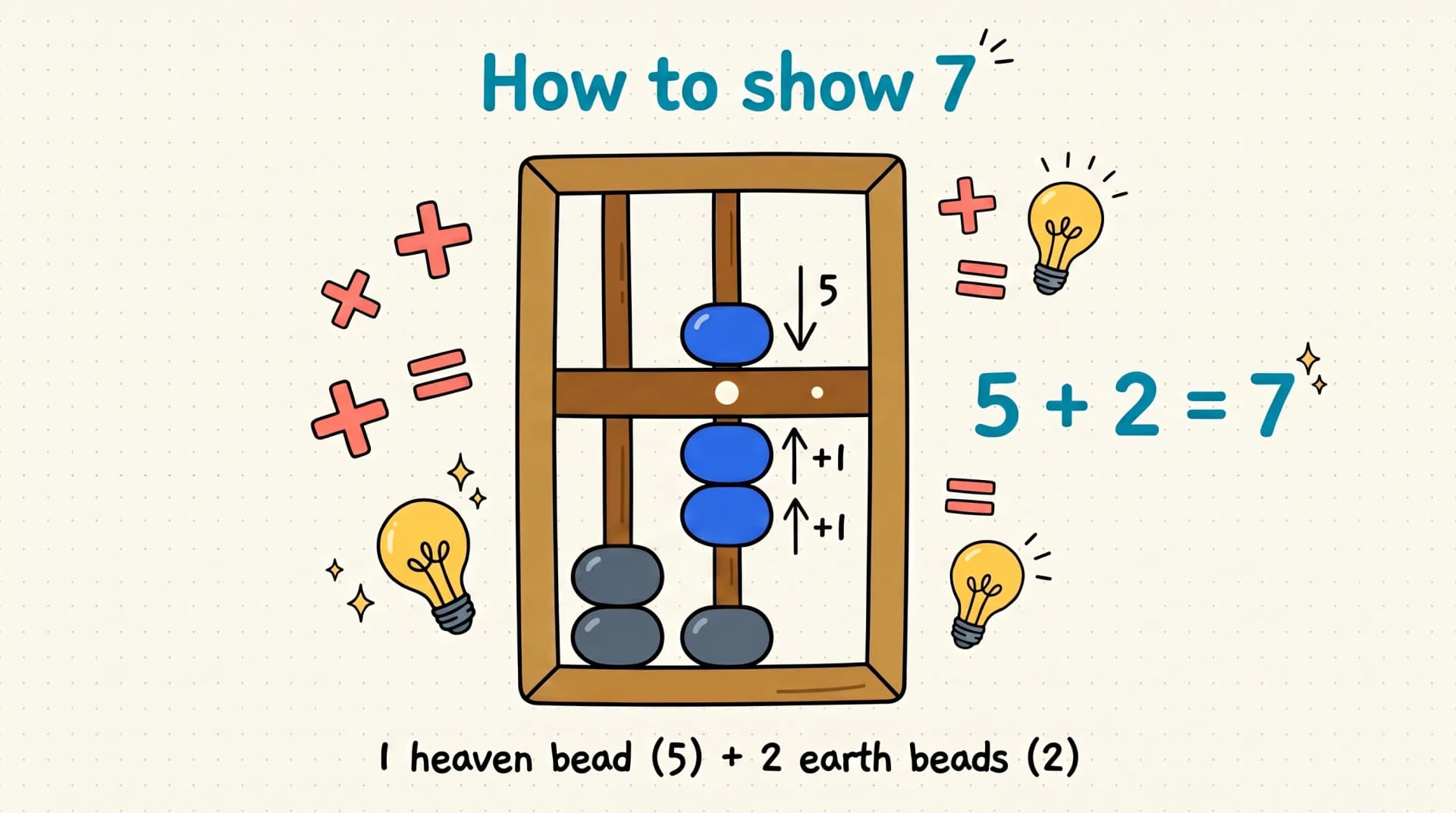
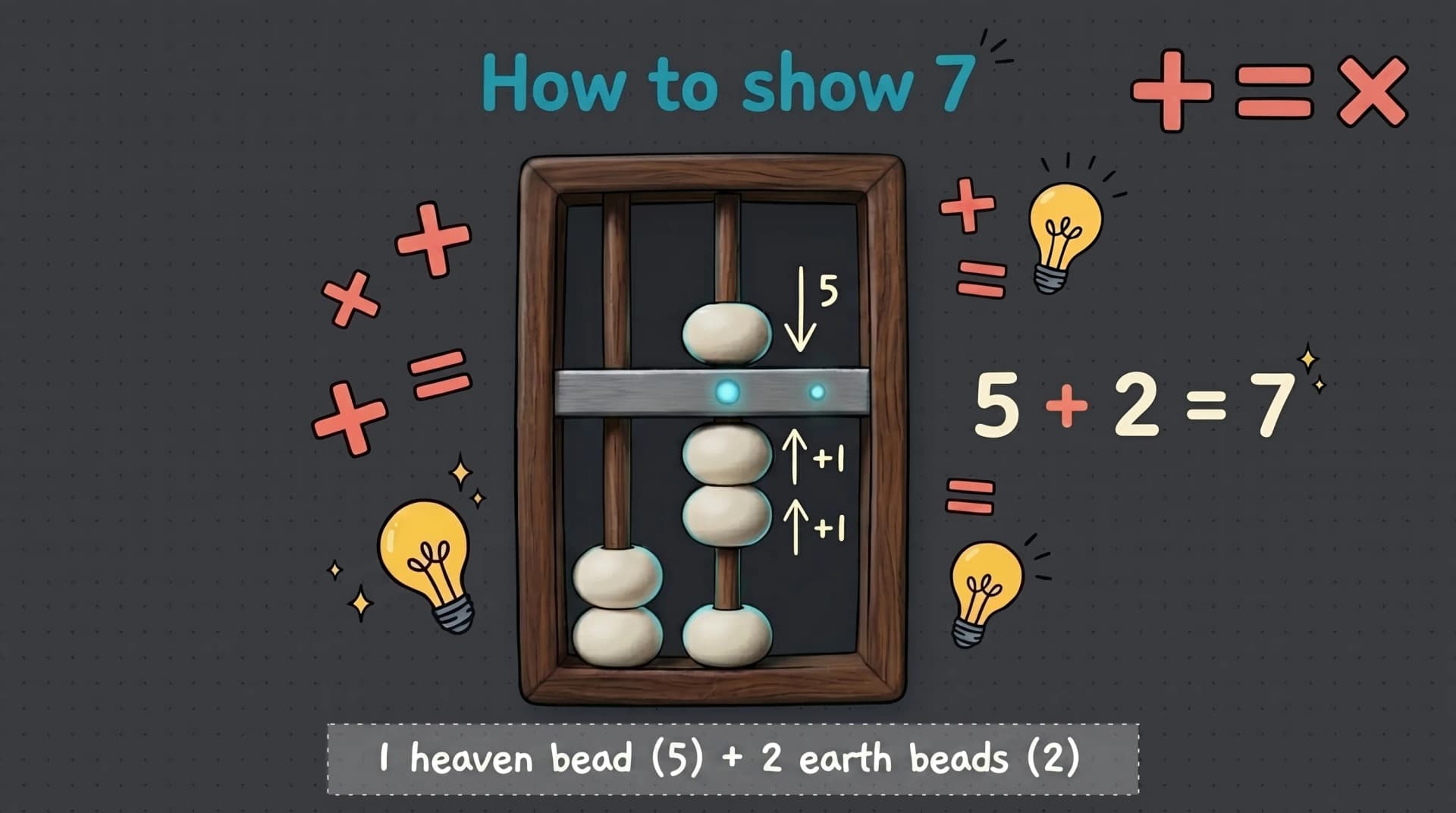
Each column on the abacus represents a single digit. For example, to represent the number7 in the ones column, you would do the following:
- Move the heaven bead down toward the bar, which gives you a value of 5.
- Move two earth beads up toward the bar, adding a value of 2.
To add 6 to that 7, you cannot simply add 5 because the heaven bead is already in use. Instead, you perform a carry operation:
- Move the heaven bead away to subtract 5.
- Move the earth beads away to subtract 2.
- Finally, add 1 to the tens column to reach 13.
In soroban training, this is known as a “small friend” formula. While it sounds complicated when written out, it becomes entirely automatic for a child after a few months of practice. They see the problem, decide on the formula, and move the beads in a fraction of a second.
Subtraction is essentially the reverse process. Multiplication is treated as repeated addition using specific column-shifting rules, and division uses subtraction with similar shifts.
The most impressive phase of training occurs when children begin to solve problems by visualising the abacus in their minds. Studies have shown that this kind of mental abacus calculation activates the brain's visual-spatial regions rather than the language centres typically used for arithmetic. This unique processing method is the reason trained children can calculate so rapidly.
Which abacus we teach on
The Japanese soroban, exclusively. It is the modern teaching standard, and it is the tool every child at this academy learns on.
Several other instruments are still in use, and the differences between them decide how well each one teaches. The Chinese suanpan, the Russian schoty, the Roman hand abacus, the colourful wooden frame sold as a toddler toy, and the question of who actually invented any of it, are all compared in the guide to the types of abacus.

What is abacus maths?
Abacus maths (spelled abacus math in the US) is the teaching method built on this tool. Instead of memorizing sums, children learn to calculate by moving beads, first on a physical soroban and later on an imagined one. That second stage is the real goal: students picture the abacus in their head and move the beads mentally, a skill known as anzan. It is why graduates of abacus maths programs can add long columns of numbers faster than most adults can type them into a calculator.
A structured abacus maths program moves through levels, introducing bigger numbers, multiplication, and division as the bead formulas become automatic.
Why kids learn abacus
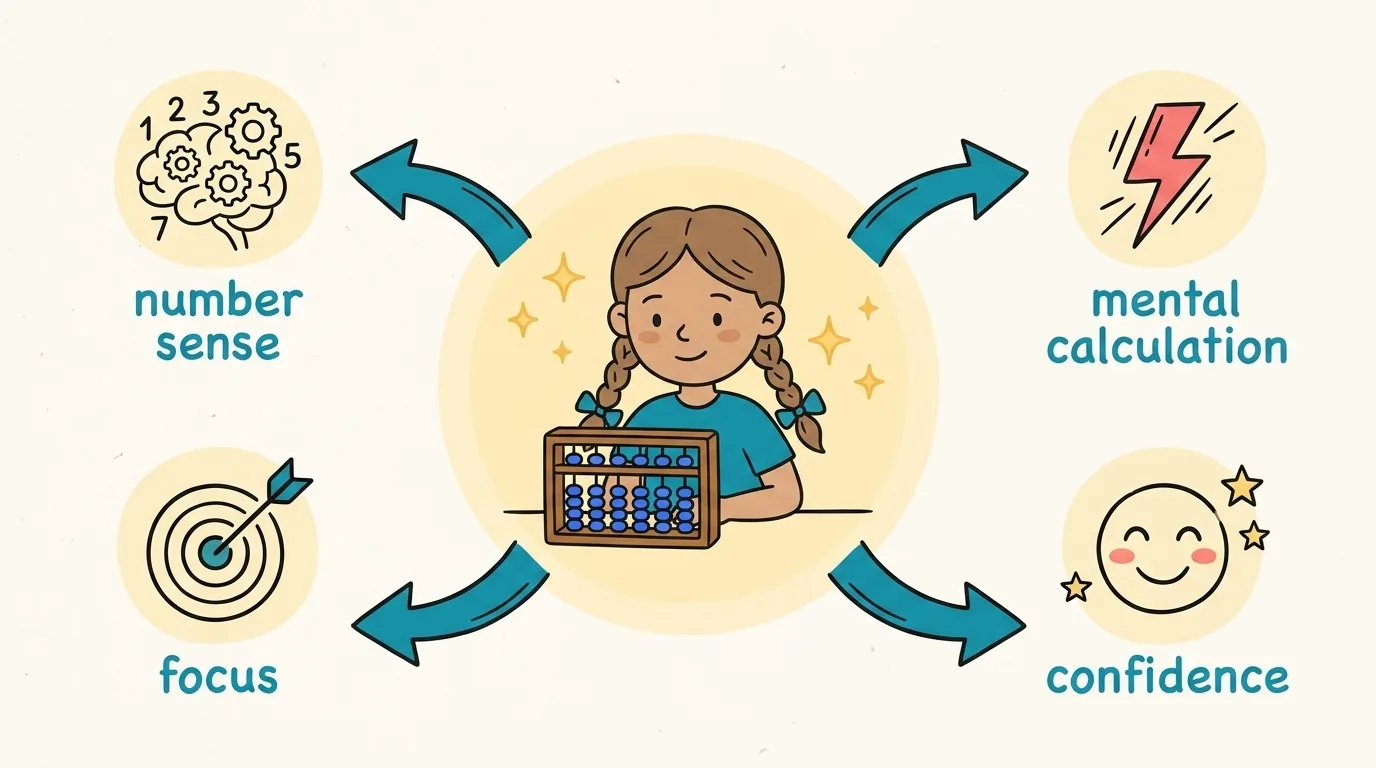
There is a strong cognitive case for abacus training. We explore this deeply in our article on the evidence-backed benefits of abacus learning. In summary, it significantly improves mental arithmetic, builds working memory, and develops sustained attention. Most importantly, it gives children a profound confidence with numbers that improves their performance across all school subjects.
At what age should kids start?
Six is considered the ideal age to begin. Younger children can certainly be introduced to the physical tool, but they rarely have the cognitive development needed for the structured curriculum. Older children can also start the program. While their early progress might feel a bit slower as they adapt their existing math habits, they quickly catch up. By the intermediate levels, a student's starting age is no longer a factor.
How many levels are there?
Reputable programs typically follow a 10-level progression. This usually takes two to three years to complete with regular practice. Students begin with simple single-digit arithmetic in Level 1 and graduate Level 10 capable of performing complex mental math at competition speed.
For a detailed breakdown of what is taught at each stage, you can read our complete guide to the 10 levels of abacus training.
Common questions
Is the spelling “abacus”, “abascus”, or “abacuse”?
The correct spelling is abacus. Common misspellings like abascus, abacuse, and abacuss all refer to the same calculating tool. The word originates from the Greek ἄβαξ (ábax), which means “tablet” or “calculating board”.
How does an abacus actually work?
Each vertical column on the abacus represents a place value, such as ones, tens, or hundreds. Beads are moved toward or away from a horizontal dividing bar to represent digits 0 through 9. Children learn a specific set of formulas to perform addition, subtraction, multiplication, and division by sliding these beads.
Is the abacus still useful in the digital age?
While calculators replaced the abacus for commercial use decades ago, it remains an incredible educational tool. It teaches children to visualize numbers and perform rapid mental calculations. This foundational skill is very different from simply pushing buttons on a calculator, and it provides a deep understanding of math that carries over directly into schoolwork.
Can adults learn abacus?
Yes, adults can learn the abacus, though progress is generally slower than it is for young children. Adult learners often reach intermediate levels within a year or so. The mental math benefits are real, but they are more modest since adult brains are less plastic and rely more on established arithmetic habits.
How many levels are there in abacus training?
Most programs use a 10-level progression that takes about two to three years to complete if attending classes twice a week. Each level takes roughly three months and concludes with a formal assessment. Students start with simple single-digit addition in Level 1 and progress to complex, multi-digit mental arithmetic at competition speeds by Level 10.
Is online abacus learning as effective as offline?
Online learning is highly effective as long as classes are small and the instructor uses a screen-shared abacus to demonstrate techniques live. The physical mechanics of moving the beads translate perfectly over video. What truly dictates success is the quality of the instructor and the consistency of the student's practice, rather than the physical location.
At what age should kids start abacus?
Six is generally the ideal starting age. While younger children can enjoy playing with the beads, they usually lack the working memory necessary for the formal curriculum. Older children can also start and see great benefits, although they may find the early levels slightly slow because they already have established ways of doing math.
Try it yourself
If you are curious to see how the mechanics work, you can try our free virtual abacus. It is a fully functional soroban that runs directly in your browser.
Alternatively, if you would like to see how the concepts are taught, we offer free 30-minute demo classes for children. They will meet an instructor and learn their first bead movements, giving you both a chance to see if it is a good fit.
For more reading, see our breakdown of the ten levels of abacus training and our list of the ten benefits of learning abacus.