How to learn the abacus online (a complete guide)
The fastest way to learn the abacus online is the same way children learn it in classrooms. Start by understanding the structure, then practice reading numbers, then move into addition, subtraction, and beyond. The interactive lessons above walk you through the first three of those steps. The rest of this section explains how to keep going.
What you will learn on this page
By the end of this page you will be able to read any number from 0 to 9,999,999 on a soroban, perform basic addition and subtraction, and recognise the steps a teacher will guide you through next. You will also learn the four named parts of the abacus, watch any number animate onto the beads, and try the tool yourself.
Step one. Understand the structure of the abacus
Every soroban has thirteen vertical columns. Each column has one heaven bead above the dividing bar and four earth beads below. The brightest dot on the bar marks the ones column. Columns to its left are tens, hundreds, thousands. Columns to its right are tenths, hundredths, thousandths. Read our overview of the abacus for the full anatomy and the history behind the tool.
Step two. Read numbers fluently
This is the foundation of everything. The first lesson on this page walks you through the digits 0 to 9 on a single column. It looks simple, but the speed at which you can recognise a bead pattern is the single biggest predictor of how fast you will calculate later. Children practise this every day for the first few weeks of class, and we recommend you do the same. The virtual abacus with Display mode is perfect for this kind of drill.
Step three. Practice addition and subtraction
Once you can read numbers, add and subtract column by column. Lessons two and three above show how. Real practice means dozens of small problems until the bead movements feel automatic. A teacher will introduce complement formulas (small mental tricks for when a column runs out of beads) at this stage. These formulas are what make the abacus faster than mental arithmetic with no tool, and they are also the first place self learners get stuck.
Step four. Multiplication, division, and mental math
The methods for multiplication, division, decimals, fractions, square roots, and mental math (anzan) build on the same beads but require structured instruction. Each is a short course on its own. A class is the right place for these because the techniques only work if your foundations are solid. Trying to self study multiplication on a soroban without a teacher usually leads to inefficient bead movements that have to be unlearned later.
How long does it take to learn the abacus?
Most structured programs use a ten level progression spread over two to three years if a child attends two classes a week. The first level (basic addition and subtraction on small numbers) takes about three months. By level four, students are doing four digit problems. By level ten, they can perform mental arithmetic at competition speed, often faster than an adult can read out the question.
What age is best to start?
Six is the sweet spot for most children. By age six, working memory is mature enough for the formal curriculum and the brain is still highly plastic. Younger children can enjoy the beads but usually need an adult to explain the math. Older children and adults can also start; the early levels just feel a little slow because they already have established ways of doing arithmetic.
Can adults learn the abacus?
Yes. Progress is slower than for children because adult brains have already fixed habits for arithmetic, but most adult learners reach intermediate levels (four digit problems) within a year of regular practice. The mental math benefits are real, just more modest than what a six year old will achieve over the same period. Many of our adult students learn alongside their kids and use the practice as bonding time.
Free abacus learning vs paid classes
This page and our free virtual abacus are completely free and always will be. They are excellent for visualising the tool, getting a feel for the beads, and learning the basics. Structured progress beyond the basics, however, requires a real instructor to teach the formulas, watch finger technique, and adjust pace to your child. A free demo class with a certified instructor is the best way to compare what self study with this page feels like versus what a real lesson feels like.
Why structured abacus training matters
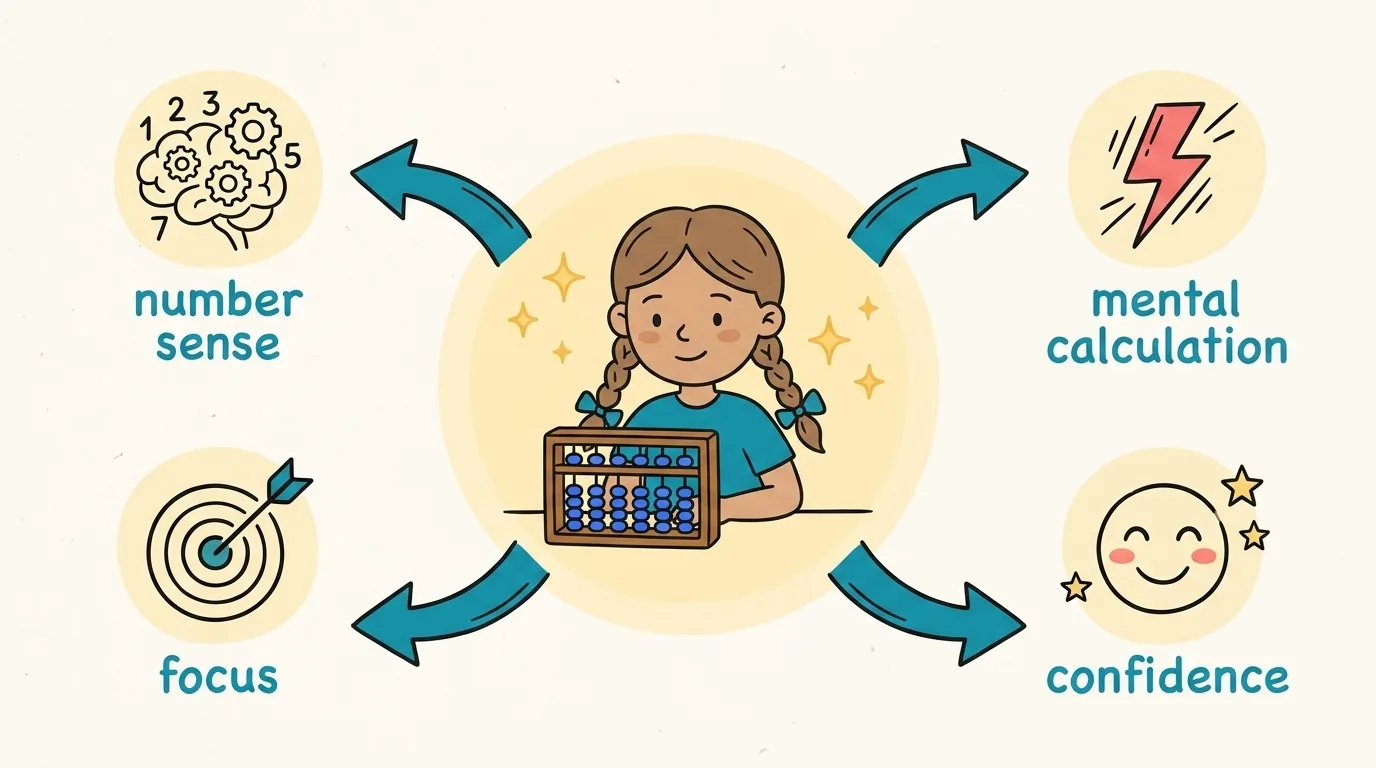
Beyond the math itself, abacus training builds focus, working memory, visualisation, and confidence with numbers. These are the same skills schools care about, and they transfer directly to algebra, science, and everyday problem solving. For a deeper look at what abacus does for the brain, read our article on the ten evidence backed benefits of abacus learning.
Common questions about learning the abacus
How can I learn the abacus online for free?
Use this page. The interactive lessons walk you through reading numbers, addition, and subtraction on a real soroban, animated step by step. Then try our free virtual abacus to practice on your own. For structured progress beyond the basics, a live class with an instructor is the next step.
What is the easiest way to learn the abacus for beginners?
Start with the structure. Recognise the four named parts: heaven bead, earth beads, dividing bar, and ones column. Next, master reading the digits 0 to 9 on a single column. Only then move into addition and subtraction. The lessons on this page follow exactly that order, which is the same order children learn in our classroom.
Can I learn the abacus without a teacher?
You can learn the basics on your own using free tools like this page. Most self learners hit a wall at the first complement formula, which is a small mental trick used when a column runs out of beads. A short class is the fastest way past that wall and into multiplication, division, and mental math.
How long does it take to learn the abacus?
The basics on this page take about an hour to grasp. A full ten level program (basic addition through competition speed mental math) takes two to three years at two classes a week. Most students reach intermediate levels (four digit problems) within a year.
What age should a child start learning the abacus?
Six is the most common starting age. Working memory is mature enough by then for the formal curriculum, and the brain is still highly plastic. Younger children can enjoy the beads but usually need an adult to explain the math. Older kids and adults can also start; progress is just slightly slower.
What is the difference between an abacus and a soroban?
Soroban is the Japanese version of the abacus. It has one heaven bead and four earth beads per column, totalling thirteen columns. Other types include the Chinese suanpan (two heaven beads, five earth beads) and the Russian schoty. The soroban is the global standard for modern teaching because its layout makes the math straightforward.
Do I need to buy a physical abacus to start learning?
No. The lessons on this page and our free virtual abacus run entirely in your browser. Once a child reaches structured classes, a physical soroban is recommended for muscle memory, but it is not required to begin.
What can the abacus calculate?
Addition, subtraction, multiplication, division, decimals, fractions, and even square roots. Trained students perform multi digit calculations faster than they can type the same problem into a calculator. Mental math (anzan) lets them visualise the soroban and compute without touching it at all.
Take the next step
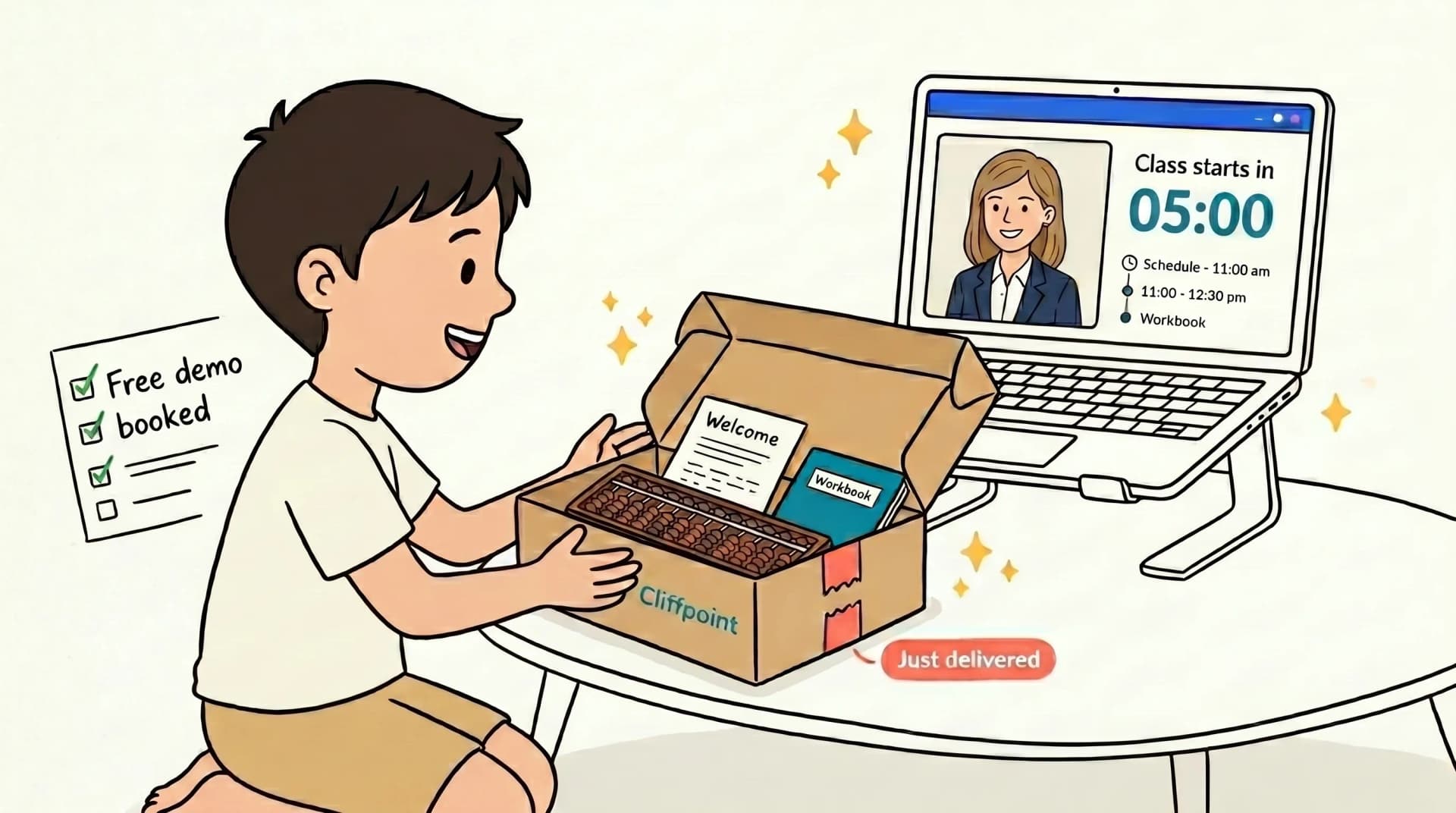
If you found these lessons helpful and want to take it further, the most useful next step is a free thirty minute demo class with a certified instructor. Your child gets a real lesson, you get to watch what structured abacus teaching looks like, and there is no obligation to enrol after.
For more reading, explore our breakdown of all ten levels of abacus training or our list of ten benefits of abacus learning.