A prospectus for parents
The ten abacus levels, from the first bead to mental maths
Ten levels, each about three to three and a half months, each ending with a graded test. No child moves up because time passed. They move up because the work says they are ready.
Read it in order. It takes about four minutes, and it answers the questions in the order parents actually ask them.
Chapter one
Two years, told through one bead
Parents ask what abacus training actually does to a child. The honest answer is not a number. It is that the instrument slowly stops being needed.
Month one
Your child moves a bead with their fingers and says the number out loud. It is slow, and it is supposed to be.
Month fourteen
The bead is still on the desk. Their hand has stopped reaching for it.
Year two
There is no bead. The answer arrives, and nobody at the kitchen table is surprised any more.
None of that is a trick, and none of it happens by month three. It is ten graded levels, taken in order, at a pace a child can actually hold.
Chapter two
How many levels are there in abacus, and what happens in each one
Ten, in this academy, grouped into four stages. The timings below are honest averages rather than promises: a child who practises fifteen minutes a day moves faster than one who does not. For the longer account of what each of the ten levels covers, read the guide. To practise between classes, we publish printable soroban worksheets for each level.
FoundationLevels 1 and 2About the first 7 months
The instrument stops being unfamiliar. Single-digit sums are already being answered without it, and multiplication has arrived far earlier than most parents expect.
- Level 01
- The bead values, the fingering, and the three formulas everything afterwards is built on. By the end of it single-digit work is happening in the head, not on the desk. Every child begins here, including the ones who already like maths.
- Level 02
- Double digits, and the first multiplication. Two skills that usually sit years apart in school arrive in the same term here.
Speed builderLevels 3 and 4Roughly months 7 to 14
Three and four figures are carried in the head, and division takes its place beside multiplication. This is the stretch where teachers start remarking on the classwork.
- Level 03
- Triple-digit sums worked mentally, and division introduced. The abacus is still on the desk, but it is consulted rather than relied upon.
- Level 04
- Four figures held in the head, with multiplication and division now running to double digits on both sides.
Mental mathsLevels 5, 6 and 7Roughly months 14 to 25
The instrument leaves the desk for good, and the arithmetic stops being about whole numbers. Decimals, negatives and percentages are absorbed into the same mental picture.
- Level 05
- Five figures in the head, and the number line opens out: decimals, sums that fall below zero, and percentages.
- Level 06
- Addition mastered outright, decimals and negatives included. This is the level where most parents stop being able to keep up.
- Level 07
- Multiplication mastered, decimal points and all.
MasteryLevels 8, 9 and 10Year 2 and beyond
Everything is done in the head, and the syllabus reaches topics school will not set for years yet. By the end your child is working at competition standard.
- Level 08
- Division mastered, decimal points and all, closing the set of four operations.
- Level 09
- Fractions, square roots and cube roots, and the factor work behind LCM and HCF.
- Level 10
- BODMAS and PEMDAS held at competition pace, with the accuracy to sit the graded final test.
- Time per level
- About 3 to 3.5 months
- Classes
- 2 a week, 1 hour each
- Practice at home
- About 15 minutes a day
- Children in a batch
- 10 at most
- Where classes run
- Online worldwide, plus hybrid and in person in Goa
Chapter three
The record, without the adjectives
500+
children taught
Across seven years of teaching, online and in Goa.
10
levels, each one tested
A level ends with a graded test, not with a date on a calendar.
10
children in a batch, at most
It is a cap, so it costs us places rather than earning them.
In their words
Three messages families sent us, unedited
Yes! He is enjoying the classes. I have never seen him so excited about math.
Thank you so much, teacher. It is due to your patience and dedication that my child has shown significant improvement. We truly appreciate your efforts.
My son's math skills improved dramatically after just three months of classes. His concentration has improved in all subjects too.
Chapter four
From the demo class to the first level, in three steps
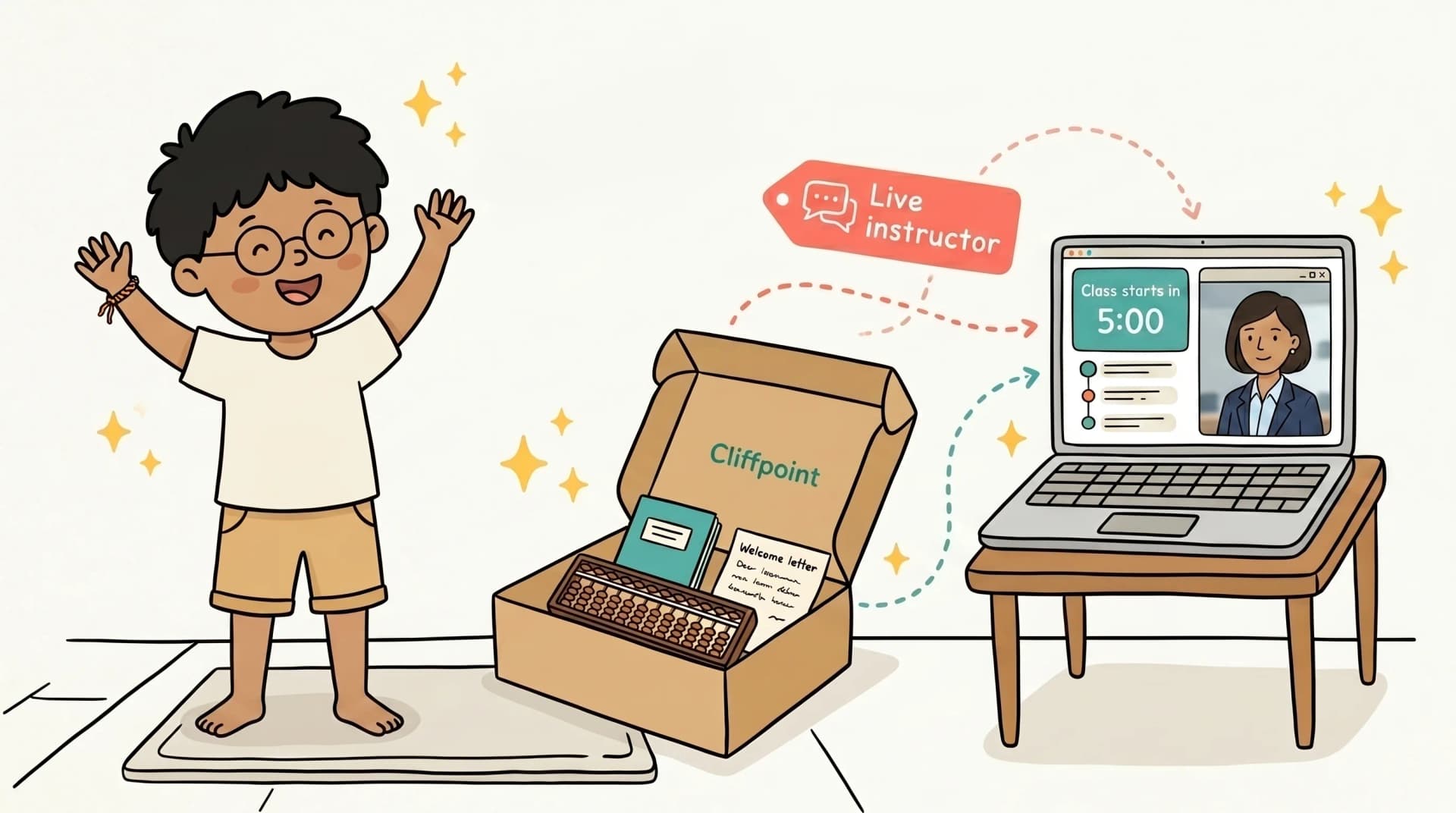
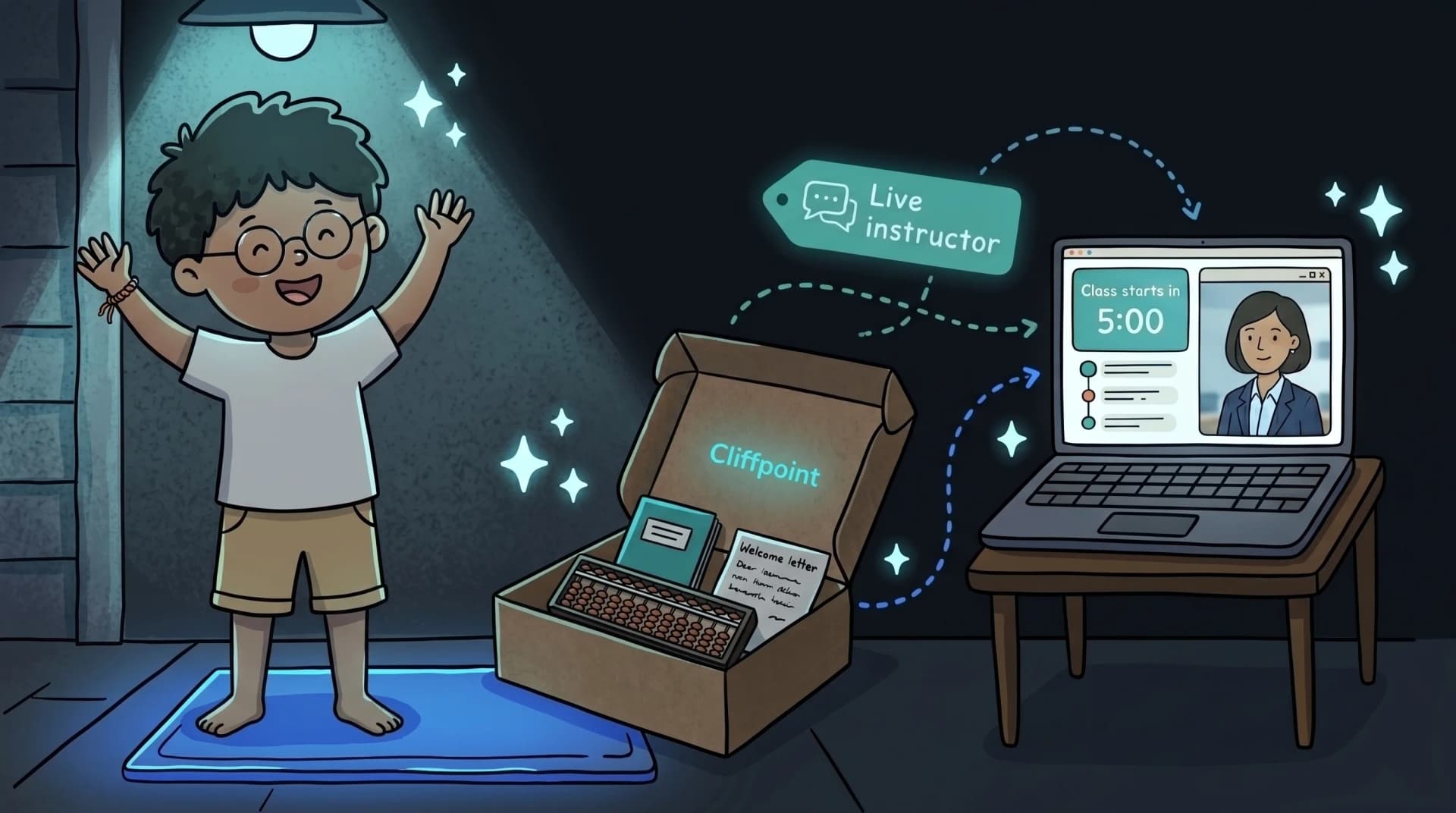
- 01
A demo class, with your child in it
Free, live, and taught by the instructor who would go on to teach them. You watch how they think, not a sales call.
- 02
The kit reaches your door
A real soroban, the workbook for the level, and a welcome letter. Everything the first term needs, in one box.
- 03
Two hours a week, on your clock
Two live classes of one hour, in a batch that fits your timezone and never holds more than ten children. Each level takes about three months.
Chapter five
How progress is measured, and proved
Is there an abacus exam at the end of each level?
Yes. Every level finishes with a graded test, and a child moves up when the test says they are ready rather than when the calendar does. It is the reason a level here is comparable to the same level a year later, and the reason we can tell you honestly where your child actually is.
Does my child get an abacus certificate?
Each completed level is recorded and recognised in the parent portal, so you can see exactly which levels your child has finished and when. Parents get told the result of every graded test rather than a vague reassurance at the end of term.
Can my child enter abacus competitions?
Abacus and mental arithmetic competitions run at state, national and international level. The ten-level curriculum builds the speed and accuracy those events need, and Level 10 is written around competition standard itself. Competing is never a requirement, and plenty of families never do it.
We are delighted to share that our daughter has completed her level today with full marks! This achievement wouldn't have been possible without your constant support.
Chapter six
The questions parents send us first
How many levels are there in abacus?
Ten in this academy, each taking about three to three and a half months and ending with a graded test. Some academies run eight, some run twelve; what matters is whether the levels are tested, because an untested level means only that time has passed.
What is the best age to learn abacus?
Between 6 and 12. Younger than six and the finger control is not there yet; much older and the habit of reaching for a calculator is already set. Every child starts at Level 1 regardless of age or how good they already are at maths.
Is abacus good for kids, or is it just a party trick?
The calculation speed is the visible part. The part parents report first is concentration: sitting with one problem for a full minute without drifting. That transfers to homework in every subject, which is why the change usually shows up outside maths first.
What happens in an abacus class?
One live hour, twice a week, with at most ten children and a certified instructor. Drills on the physical soroban, then visualisation work as the levels progress, then a set for home that takes about fifteen minutes a day. Classes are live and never recorded.
Does my child need to be good at maths already?
No, and it is often the children who dislike maths who change the most, because the abacus gives them something to picture instead of something to memorise. The demo class will tell you honestly whether the fit is right.
What if we start and it does not suit my child?
You will know inside the free demo class, which is a real lesson rather than a presentation. Nothing is charged before it, and nobody is asked to commit during it.
More answers on the full FAQ, or read what an abacus is and how to use one. You can also try the free virtual abacus before you decide.
The invitation
Ten seats per batch.
One of them could be your child's.
We cap every batch at ten children, so every child is heard in every class. The demo class is open to everyone who applies. Seats are offered by invitation after the class, and an invitation stays valid for 14 days.
Is Cliffpoint right for your family?
- Your child is between 6 and 12
- They can attend two live classes a week
- You can support 15 minutes of practice a day
Apply for a Demo Class
The 30-minute free demo class is a real lesson: your child works on a soroban with our instructor while you watch how it is taught. Tuition is quoted in your local currency on the call. Applying takes about two minutes.
- Certified instructor, 7+ yrs
- 500+ students trained
- Live, never recorded
“I was skeptical at first, but the results speak for themselves. My daughter can now calculate faster than I can with a calculator!”
How admission works
- 1Apply for a demo class. Takes about 2 minutes
- 2A live 30-minute lesson with your instructor
- 3An invitation to take a seat, valid 14 days
The demo class is open to everyone who applies. Seats are offered by invitation after the class. We respond within 24 hours.
Prefer email? Write to us directly