Four acronyms, four countries, one rule. If your child has come home insisting the answer is 9 and you are equally certain it is 1, this is almost always what has happened. Here is what each letter stands for, and the single detail that causes nearly every disagreement.
Somewhere around Year 5 or Grade 5, a sum comes home that causes an argument. It usually looks harmless, something like 6 + 2 × 3. One person in the house says 24. The other says 12. Both are certain.
The rule that settles it has four different names depending on where you went to school, which is not helpful when a parent and a child were schooled in different countries. So here is all four of them, and the one detail that causes nearly every disagreement.
What does BODMAS stand for?
Brackets, Orders, Division, Multiplication, Addition, Subtraction. Orders means powers and roots, so 3 squared or the square root of 16. It sets the order in which the parts of a calculation are worked out.
So in 6 + 2 × 3, the multiplication happens before the addition. 2 × 3 is 6, then 6 + 6 is 12. The answer is 12, not 24. Working strictly left to right is the single most common mistake, and it is the one most adults make when they have not thought about this since school.
Is BODMAS the same as PEMDAS?
Yes. They are the same rule with different words. PEMDAS stands for Parentheses, Exponents, Multiplication, Division, Addition, Subtraction. Parentheses and brackets are the same thing, and exponents and orders are the same thing. The only apparent difference is that PEMDAS lists multiplication before division while BODMAS lists division first, and that difference is not real because multiplication and division rank equally.
That last sentence is the whole article, really. Hold on to it.
What is the difference between BODMAS, BIDMAS, BEDMAS and PEMDAS?
Only the words. BODMAS uses Orders, BIDMAS uses Indices, BEDMAS uses Exponents and PEMDAS uses Parentheses and Exponents. Orders, indices and exponents all mean powers and roots. Brackets and parentheses are the same thing. BODMAS and BIDMAS are taught in the UK, India, Australia and New Zealand, BEDMAS in Canada, and PEMDAS in the United States.
If your family spans two of those school systems, nobody is wrong. You have simply been handed the same instruction in two dialects.
The part that trips everyone up
Six letters look like six steps. They are not. They are four jobs, and two of those jobs contain a pair of equals.
- Brackets first.
- Then powers and roots.
- Then multiplication and division together, working left to right.
- Then addition and subtraction together, working left to right.
Multiplication does not beat division. Addition does not beat subtraction. Whichever comes first as you read across the line goes first.
Try 12 ÷ 4 × 3. Someone applying six strict steps will do the multiplication first, get 12 ÷ 12, and answer 1. Working left to right gives 3 × 3, which is 9. Nine is correct.
Now try 10 − 4 + 2. Six strict steps gives 10 − 6, so 4. Left to right gives 6 + 2, which is 8. Eight is correct.
Nearly every order-of-operations argument in the world is one of those two sums wearing a different costume.
Why do people get different answers to the same sum?
Almost always because they treat the four steps as six. Multiplication and division rank equally and are worked left to right, and addition and subtraction rank equally and are worked left to right. Someone who does all the multiplication before any division, because the M comes before the D in the acronym, will get a different answer.
The viral sums that circulate every few months are built deliberately on this. They are not clever, and they are not a test of intelligence. They are a test of whether you were taught four jobs or six letters.
How do I explain the order of operations to a child?
Give it as four jobs rather than six letters: do the brackets, then the powers, then multiply and divide going left to right, then add and subtract going left to right. Children who learn six separate steps tend to apply them strictly in order, which is where the mistakes come from.
Two things help more than repetition. The first is writing each step on its own line rather than trying to hold the whole calculation in the head at once. The second is asking the child to say out loud which job they are doing before they do it. Both slow the sum down at exactly the point where speed causes the error.
Where the arithmetic underneath comes in
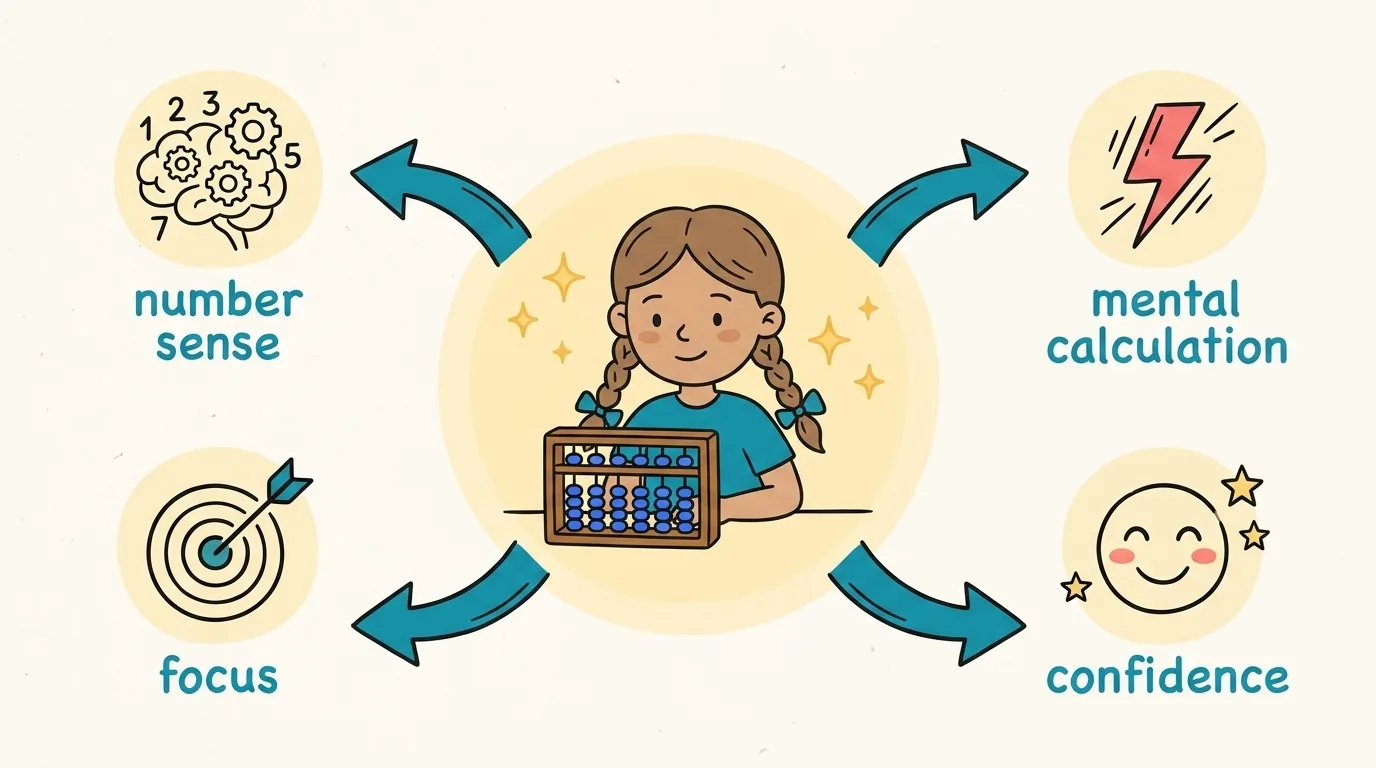
Here is the uncomfortable part. A child who is still counting on their fingers to work out 6 × 7 has no attention left over for the order of operations. The rule is not difficult. Holding the rule in mind while simultaneously calculating is what is difficult.
That is why children who are fluent with their number facts tend to stop making these mistakes almost by themselves. When 2 × 3 costs nothing to retrieve, the whole of the child's working memory is free to track which job comes next. There is more on that in helping a child get better at maths, and it is the reason abacus training tends to show up in schoolwork that has nothing to do with beads.
If you want to work on the fluency underneath, the free printable worksheets and the times tables charts are a reasonable place to start, and neither of them costs anything.