Mentals come home in the school bag most weeks and rarely with any instructions for the parent. This is what they are for, what a reasonable speed looks like at each year level, and how to help a child who is getting them right but slowly.
Mentals arrive in the school bag without a covering note. There is a sheet, there is often a time on it, and there is a child at the kitchen table who either flies through them or grinds. Most parents are never told what the sheet is actually measuring, which makes it hard to know whether to worry.
What are maths mentals?
Mentals are short sets of arithmetic questions, usually between twenty and fifty, that a child answers in their head rather than by written working. Australian primary schools set them regularly, often daily or weekly, and often with a time limit. The purpose is fluency with number facts rather than problem solving.
That distinction matters. A mentals sheet is not testing whether your child can do maths. It is testing whether the small facts underneath the maths have become automatic.
Why are maths mentals timed?
Because the point is retrieval, not calculation. A child who works out 7 plus 8 by counting on will get the right answer given enough time, but they have not learned the fact. The time limit is what distinguishes recalling an answer from reconstructing it. It is a diagnostic tool rather than a race.
This is also why a perfect score can hide a problem. Twenty out of twenty in four minutes and twenty out of twenty in ninety seconds are telling you two quite different things about the same child.
How fast should my child be at mentals?
There is no official Australian benchmark, so treat any number loosely. The closest published standard is the English Year 4 multiplication tables check, which allows six seconds per question and is designed to separate recall from working an answer out. Speed matters far less than the pattern: consistent pace with occasional errors is healthy, while long pauses on particular facts show exactly which ones are not yet known.
That is a sanity check, not a target, and schools vary in what they set. The far more useful thing you can do is watch where the pauses fall.
Read the pauses, not the score
Sit near your child for one sheet, without commenting, and mark the questions they hesitate on. Most children have a surprisingly small set of trouble spots, and the same ones recur every week. Commonly it is the sevens and eights, the bridging-through-ten additions like 8 plus 6, and any subtraction that crosses a ten.
That short list is the entire piece of work. Practising all of the tables when a child only stumbles on four facts is how mentals practice becomes a joyless nightly ritual for no gain.
My child gets mentals right but is very slow
It is worth addressing, but it is not a sign of poor ability. Slow and correct usually means the child is calculating each answer rather than recalling it. That works until the numbers get bigger, at which point the effort of the arithmetic crowds out the actual maths. The fix is targeted practice on the specific facts causing the pauses, not more sheets overall.
You tend to see the cost of this later, in Year 5 and 6, when problems have several steps. A child spending their attention on 6 times 7 has none left for the question they were actually asked. The arithmetic was never the point, but it becomes the bottleneck.
How can I help with mentals at home without making it stressful?
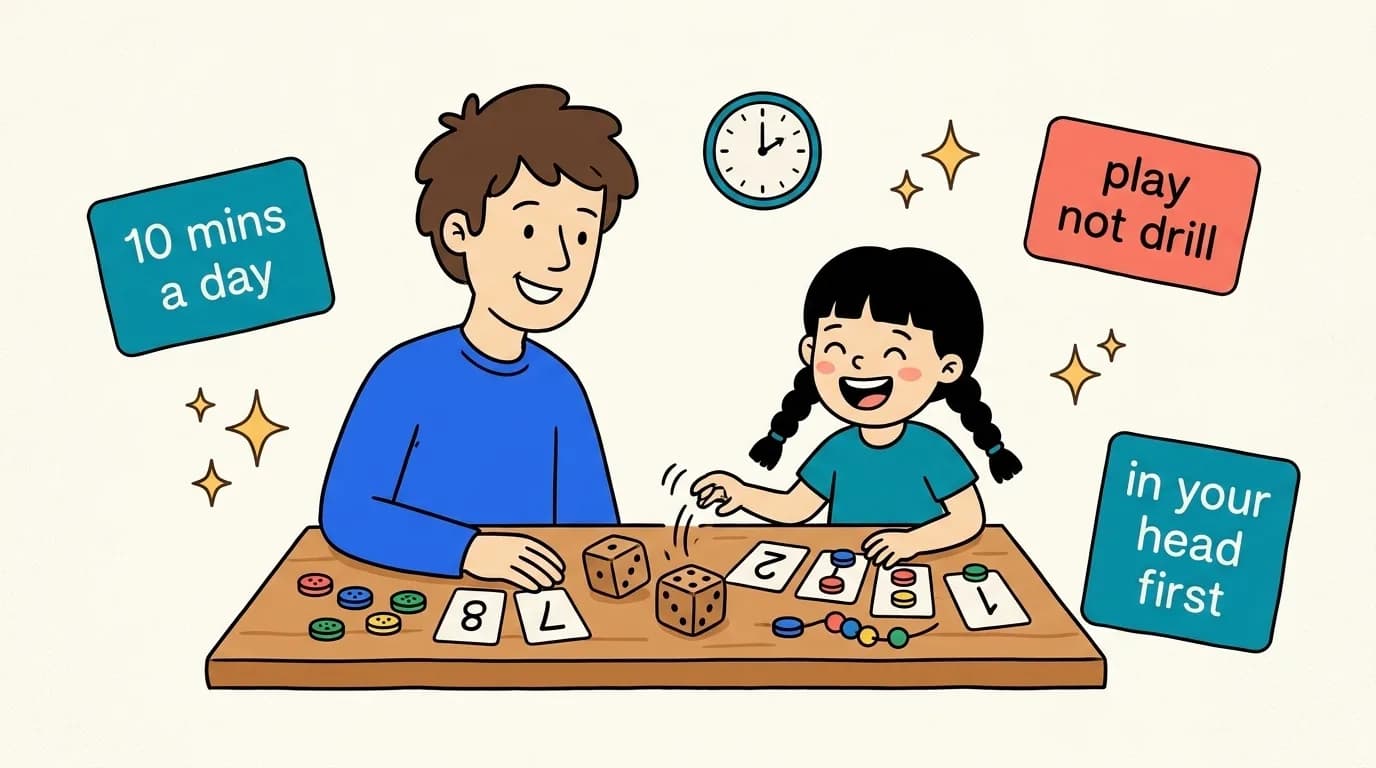
Keep sessions to five or ten minutes, work on the small set of facts your child actually hesitates on rather than the whole range, and separate practice from testing so the timer is not always running. Announcing a time to beat every session turns a fluency exercise into a performance, which tends to slow children down rather than speed them up.
Three things that reliably help:
- Practise in the car, at the shops, anywhere that is not a desk. Fact recall does not need a worksheet, and moving it away from the homework table removes most of the dread.
- Work in one direction at a time. A child who knows 6 times 7 does not automatically know 42 divided by 7. They are separate facts and both need saying out loud.
- Stop while it is still going well. Ending a session on a run of correct answers does more for next week than pushing through to the last question.
Where mental arithmetic training fits
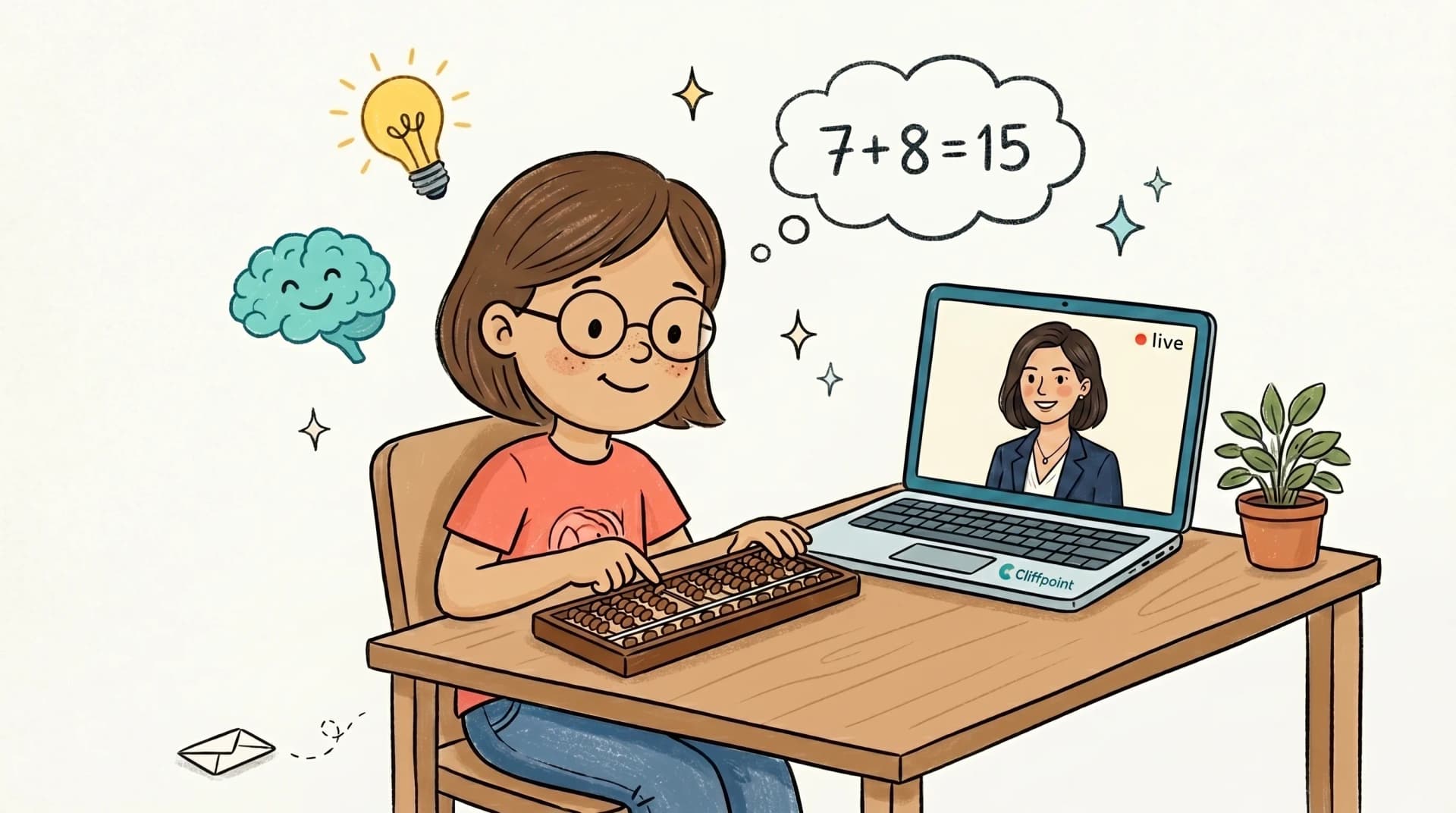
Mentals reward exactly one thing: numbers that are held as pictures rather than reconstructed as sums. That is also what abacus training builds, which is why it tends to show up in mentals scores before it shows up anywhere else. A child who has learned to see the beads is not counting, and not counting is the whole difference between three seconds and one.
It is not the only route, and it is not necessary. Plenty of children get there through ordinary practice on the facts they find hard. But if the pauses have not shifted after a term of practice, a structured mental arithmetic method is worth considering. You can see what the training actually involves in the ten-level curriculum, try the virtual abacus in your browser, or print the free worksheets and see how your child finds them. If you would rather watch it taught, our online abacus classes for Australian families run in real after-school AEST and AEDT slots and begin with a free demo lesson.
For the wider picture on what actually moves a child's maths, rather than just their mentals sheet, there is more in helping a child get better at maths.