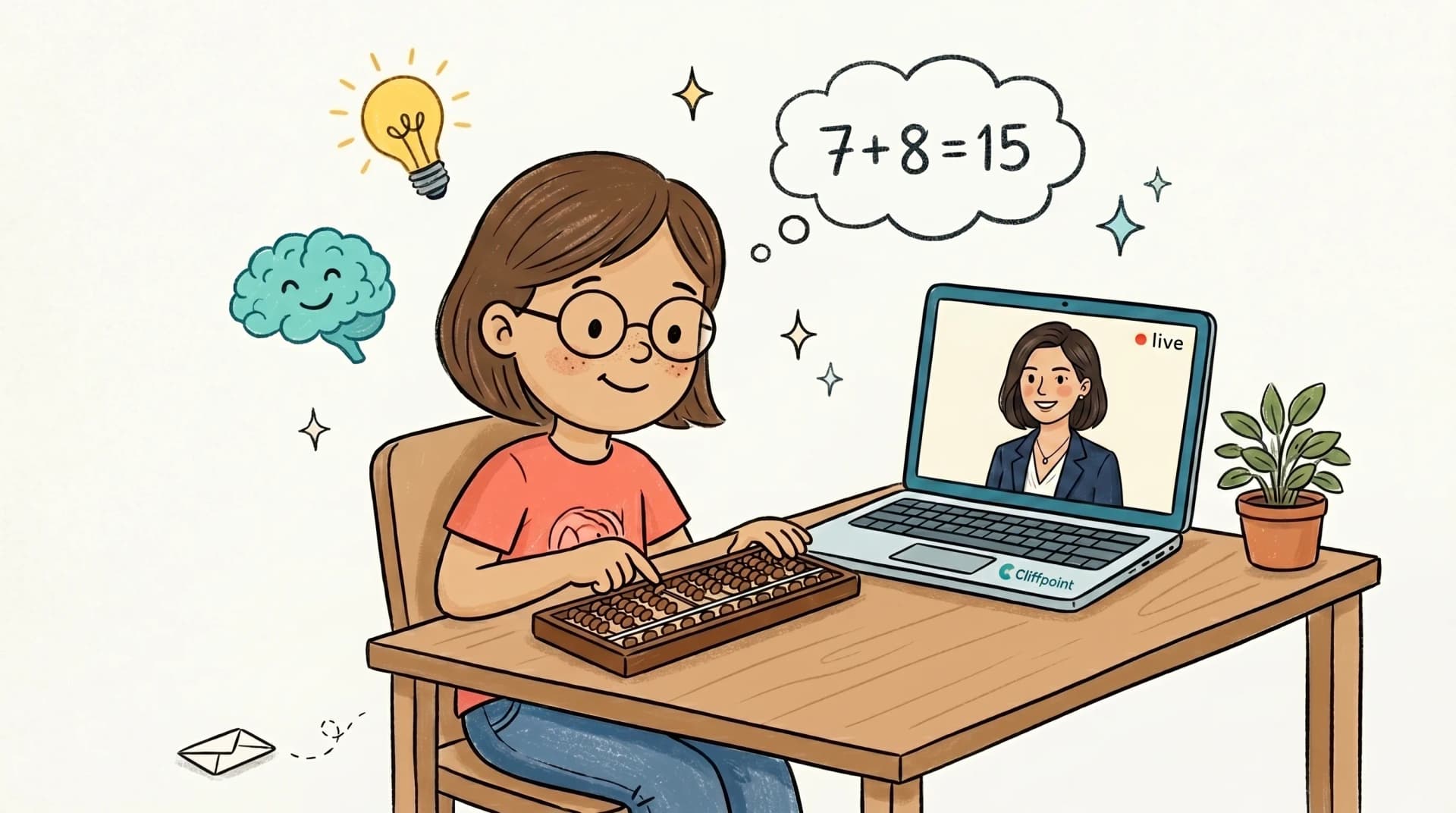

Maybe a soroban arrived in a starter kit, or your child came home from a class talking about beads, and now there is a wooden frame on the table that you are not sure how to use. This guide walks you through it from zero: the parts, how to read and set numbers, the finger movements, and your very first sum. No prior maths needed.
Maybe a soroban turned up in a starter kit, or your child mentioned it after a class, and now there is a frame of beads on the table that you are not sure how to hold, let alone use.
Good news: the soroban (the Japanese abacus) is far simpler than it looks. In a few minutes you will be able to read it, set any number on it, and do your first sum. Here is how it works, step by step.
The parts of a soroban
Hold the soroban flat with the long side towards you. You will see:
- Rods: the vertical rods, each one a place value. The rod on the far right is the ones, the next is the tens, then hundreds, exactly like written numbers.
- The reckoning bar: the horizontal bar that splits each rod into a top and a bottom.
- One heaven bead above the bar on every rod, each worth 5.
- Four earth beads below the bar on every rod, each worth 1.
A bead only counts when it is pushed towards the bar. Beads sitting away from the bar are switched off and count as zero. That one idea is the whole secret of the soroban.
How to clear (reset) the soroban
Before any sum, you clear the soroban so it reads zero: push every earth bead down, away from the bar, and every heaven bead up, away from the bar, so nothing is touching it. On a real soroban there is a quick flick to do this, but simply moving all the beads away from the bar by hand is perfectly fine when you are starting out. Now it reads zero and you are ready.
How to read a number on a soroban
To read any rod, add up only the beads touching the bar:
- No beads touching the bar = 0.
- One earth bead up to the bar = 1. Two = 2, three = 3, four = 4.
- The heaven bead down to the bar = 5.
- The heaven bead down and two earth beads up = 5 + 2 = 7.
Each rod gives you one digit, and you read the rods left to right just like a written number. So if the hundreds rod shows 2, the tens shows 0, and the ones shows 7, the soroban is showing 207.
How to set a number
Setting a number is just reading in reverse: move beads to the bar until each rod shows the digit you want. A few examples on the ones rod:
- 3: push three earth beads up to the bar.
- 5: push the heaven bead down to the bar (earth beads stay down).
- 6: heaven bead down (5) plus one earth bead up (1).
- 8: heaven bead down (5) plus three earth beads up (3).
Try setting your child’s age, or your house number. Once setting numbers feels easy, you are ready to calculate.
The finger technique
The soroban is designed to be worked with just two fingers of one hand, usually the right:
- Thumb: pushes earth beads up, towards the bar.
- Index finger: pushes earth beads down, and moves the heaven bead both ways.
It feels fiddly for the first day and then becomes automatic. Using the correct fingers is worth the effort, because it is what eventually lets a child move at speed.
Your first sum: simple addition
Start with sums that do not need any carrying. Clear the soroban, then try 21 + 6:
- Set 21: two earth beads up on the tens rod, one earth bead up on the ones rod.
- Add 6 on the ones rod: push the heaven bead down (5) and one more earth bead up (1).
- Read the answer: the tens rod shows 2, the ones rod shows 7. That is 27.
That is real calculation on a soroban. Bigger sums, like 8 + 7, need a small trick called a complement, where you swap the heaven bead in and carry to the next rod. Complements are the heart of the method, and they are best learned in order with a teacher guiding each step, rather than from a single article.
Practise without buying anything
You do not need to own a soroban to try all of this. Our free virtual soroban works in your browser, so you and your child can read, set, and add numbers together right now. If you want to understand how the soroban compares to other abacuses first, see soroban vs abacus.
How children learn this properly
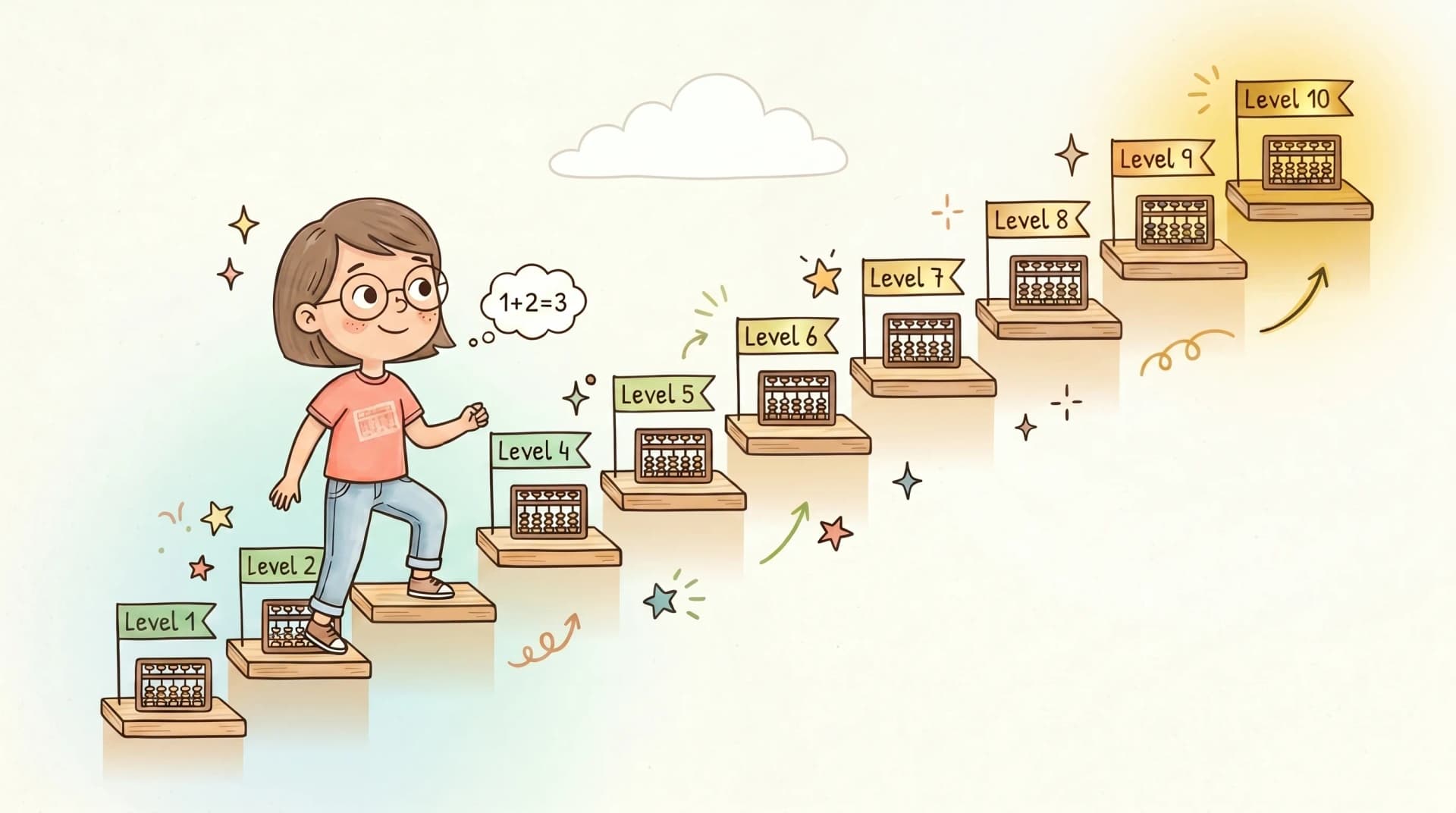
Reading and setting numbers takes minutes. The real skill, calculating quickly and then in your head, is built step by step over months, which is why children learn it in structured classes rather than from a booklet. If you are wondering when to start, read the right age to start abacus, or apply for a free demo class to watch a teacher take your child through their first beads.
Frequently asked questions
How do you read a number on a soroban?
Add up only the beads pushed towards the central bar on each rod. An earth bead below the bar is worth 1 and the heaven bead above it is worth 5, so a rod with the heaven bead and two earth beads at the bar reads 7. Each rod is one digit, read left to right.
Which fingers do you use on a soroban?
Just the thumb and index finger of one hand. The thumb pushes the lower earth beads up, and the index finger pushes them down and moves the upper heaven bead. Using the correct fingers is what allows speed later.
Is a soroban hard to learn?
Reading and setting numbers takes only a few minutes to grasp. Calculating fluently takes regular practice over months, but each step is small, which is why children as young as six manage it well.
Can I learn soroban at home?
You can certainly learn the basics at home, especially with a free virtual soroban to practise on. Most families find that a teacher makes the bigger steps, like complements and mental calculation, far easier and faster to learn correctly. When you reach that point, our live soroban classes in the UK and abacus classes in Dubai and the UAE both begin with a free demo lesson.