
Ask for “an abacus” and you could be handed any of five quite different objects. Two of them are precision calculating instruments with centuries of method behind them. Two are historical curiosities. One is a nursery toy. Telling them apart takes about two minutes, and it saves parents from buying the wrong thing.
What are the main types of abacus?
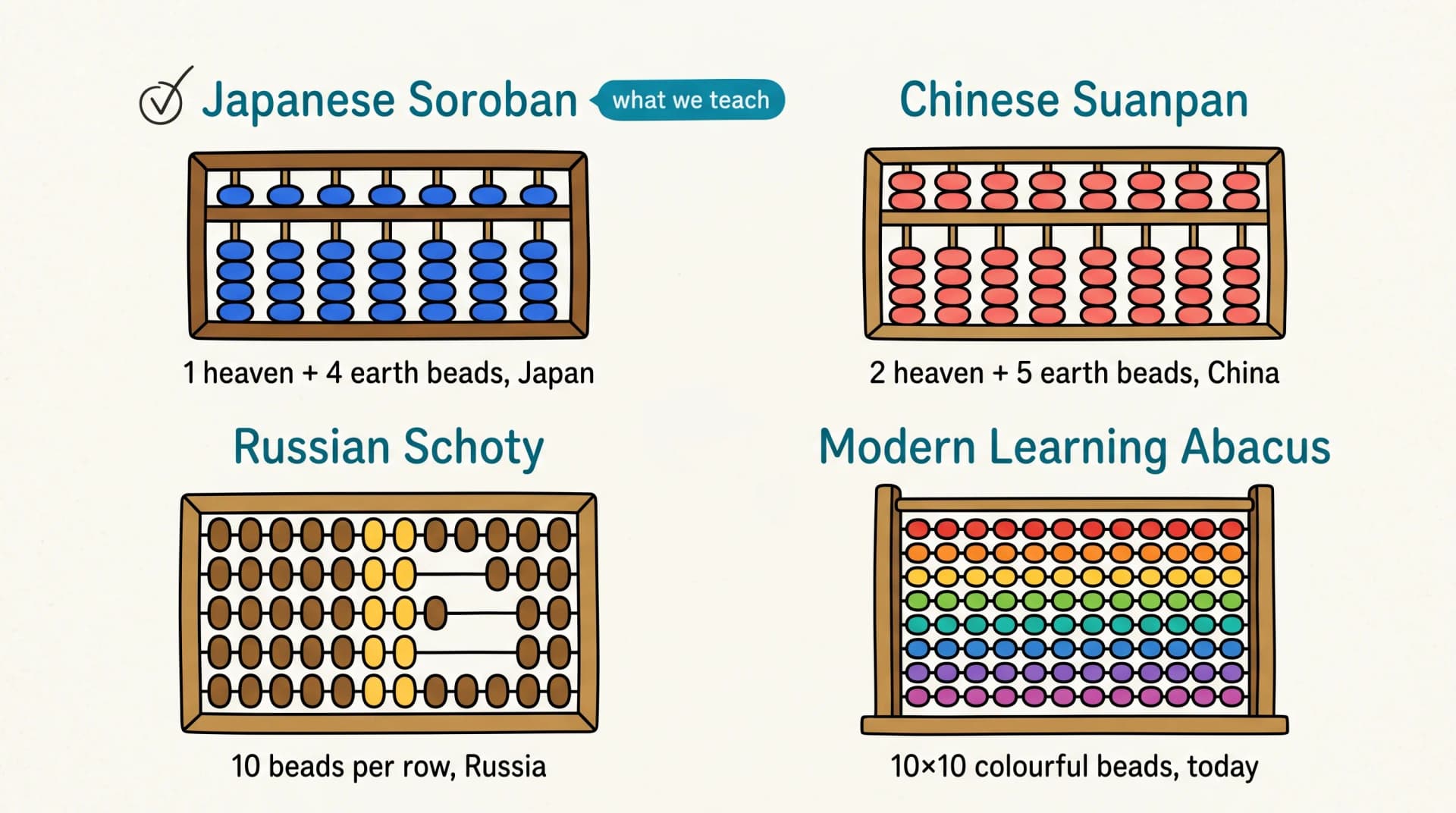
The five you are most likely to meet are the Japanese soroban, the Chinese suanpan, the Russian schoty, the Roman hand abacus, and the modern school counting frame. The soroban and the suanpan are the two used for serious calculation, the schoty and the Roman abacus are largely historical, and the counting frame is an early-years counting toy rather than a calculating instrument.
| Type | Origin | Beads per column | Still taught |
|---|---|---|---|
| Soroban | Japan, from roughly the 16th century; current form 20th century | 1 upper, 4 lower | Yes, widely |
| Suanpan | China, documented by roughly the 13th century | 2 upper, 5 lower | Yes, less commonly |
| Schoty | Russia, from roughly the 17th century | 10 per wire, plus one 4-bead wire | Rarely |
| Roman hand abacus | Roman Empire | Grooved metal, sliding markers | No, historical only |
| School counting frame | Modern classrooms worldwide | 10 per row, coloured | Yes, for early counting |
The Japanese abacus: the soroban
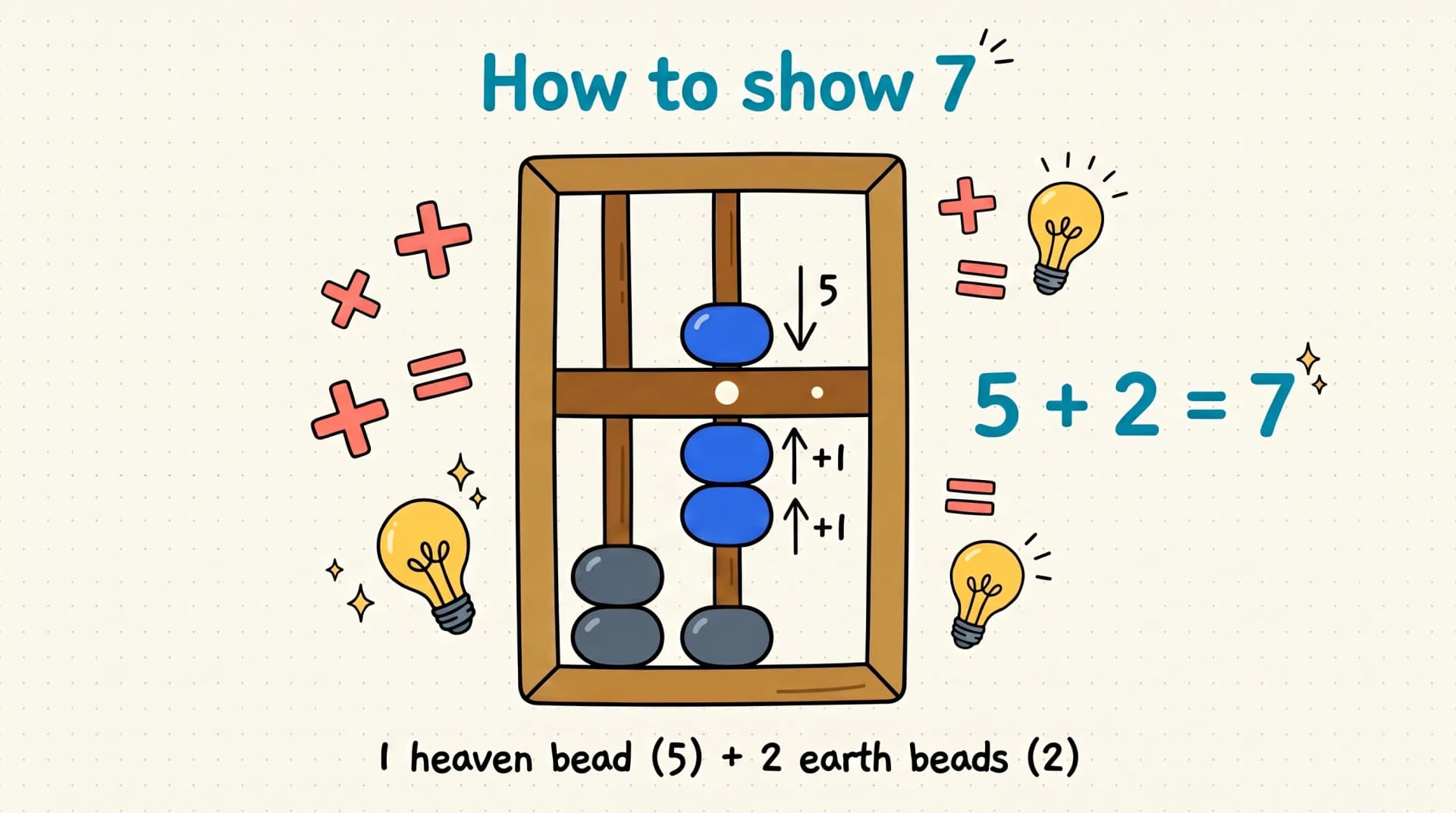
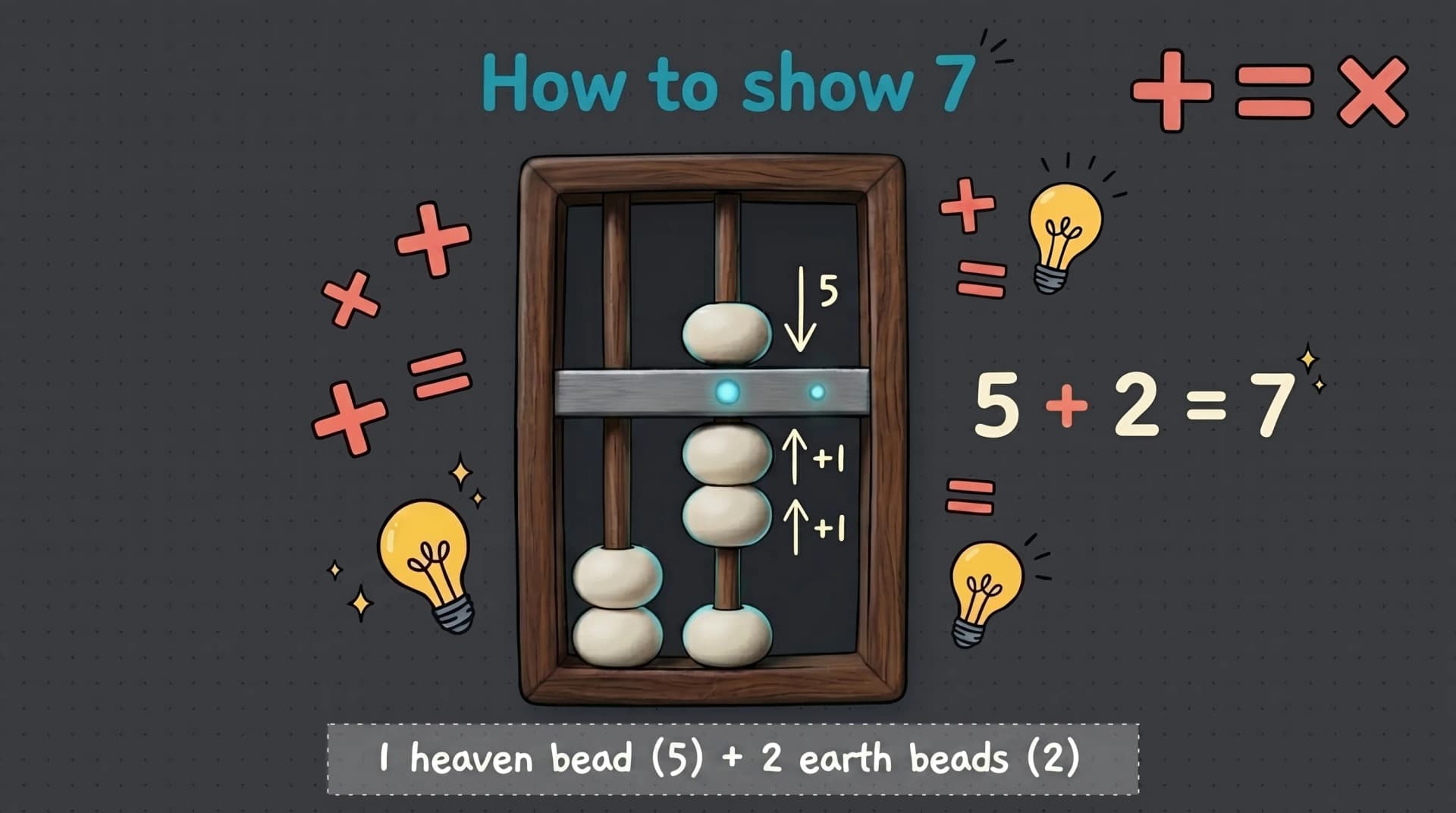
The soroban is the modern standard for teaching. Each rod carries one bead above the dividing bar, worth five, and four beads below it, each worth one. That gives every digit from 0 to 9 exactly one appearance on the frame.
That single detail is why it won. A child who is learning to picture the beads in their head, which is the whole point of abacus training, is always picturing the same shape for the same number. There is nothing to disambiguate and nothing to unlearn. The soroban is still taught in Japanese primary schools today, and it is the tool we teach on.
If you want the mechanics rather than the taxonomy, the free step-by-step lessons walk through reading numbers, addition and subtraction on a soroban, and you can try one in your browser on the virtual abacus.
The Chinese abacus: the suanpan
The Chinese abacus is called the suanpan, written 算盤, which translates roughly as calculating tray or reckoning board. It has two beads above the dividing bar and five below it on each rod, giving fifteen units per column.
Those extra beads are not decoration. They let the suanpan work comfortably in base sixteen, which mattered a great deal when Chinese weights were divided into sixteen parts, and they allow calculation methods that carry differently from the Japanese ones. The suanpan is documented by roughly the thirteenth century and is still in use, though far less commonly in teaching.
For decimal arithmetic the extra beads earn nothing, and they cost something real: several bead arrangements can show the same digit, so the mental image is no longer unique. That is the trade the soroban removed.
What is the difference between the soroban and the suanpan?
The soroban has one bead above the bar and four below, so each column can show a digit from 0 to 9 in exactly one way. The suanpan has two above and five below, so several bead arrangements can represent the same digit. Both calculate decimal arithmetic perfectly well, but the soroban's single unambiguous representation is easier for a child to hold as a mental picture, which is why it became the standard teaching tool. There is a longer treatment of that comparison in soroban versus abacus.
The Russian abacus: the schoty
The schoty takes a different approach again: ten beads on almost every wire, one short wire of four beads for fractions of a rouble, no dividing bar at all, and the two middle beads usually coloured differently so the eye can find the halfway point. The wires are typically curved so the beads stay where they are put.
It is genuinely quick for shop arithmetic, and it stayed in daily commercial use in Russia well into the twentieth century. But with no bar and no five-bead, there is no compact place-value shape to memorise, and mental visualisation is much harder. It is rarely used for teaching mental arithmetic today.
The Roman hand abacus and older counting boards
Before beads on rods there were markers in grooves. The Roman hand abacus was a small metal plate with slots and studs that slid along them. Its predecessor was a marked counting board worked with loose pebbles, and the Latin for pebble, calculus, is where our word calculate comes from.
Older still is the Salamis Tablet, a marble counting board from ancient Greece dating to around the fourth century BC, and the oldest surviving counting board we have. These are historical instruments. Nobody is taught on them.
Who invented the abacus?
No single person invented it. Counting boards appear independently in several ancient civilisations, and the oldest surviving example, the Salamis Tablet, is a marble counting board from ancient Greece. The bead-and-rod abacus that most people picture today is a later development, refined over centuries in China and then in Japan.
Pages that name an inventor and a date are guessing. The honest answer is that the idea of a physical place-value board occurred to many different people, and the instrument we teach on is the end of a long refinement rather than anyone's invention.
The origin story on its own, from the Salamis Tablet through the suanpan to the soroban, along with where the word itself comes from, is set out in what is an abacus.
Was the abacus invented in India?
This one comes up often and deserves a careful answer. Ancient India had a rich tradition of counting and calculation, and it gave the world the decimal place-value system and the numeral zero, without which none of these instruments would work as they do. That is a larger contribution than inventing any single device.
But the bead-and-rod abacus itself is not an Indian invention. Counting boards were in use across Mesopotamia, Greece, Rome, China and India, and the specific bead-on-rod form was developed in China and later refined in Japan. So the honest position is that India invented the number system the abacus expresses, not the frame.
Was the abacus the first computer?
It is often called that, and school textbooks frequently say so. The phrase is a useful shorthand rather than a literal fact. The abacus is a calculating aid: it stores a number and lets a person move it according to rules they have memorised. It does not compute anything by itself, it has no instructions of its own, and it cannot run unattended.
What is fair to say is that the abacus is the oldest calculating device still in everyday use, and the first tool that let people hold and manipulate place value physically. If a homework question asks whether the abacus was the first computer, the answer worth writing is that it was the first calculating device, and that the first machines that computed on their own came much later.
How old is the abacus?
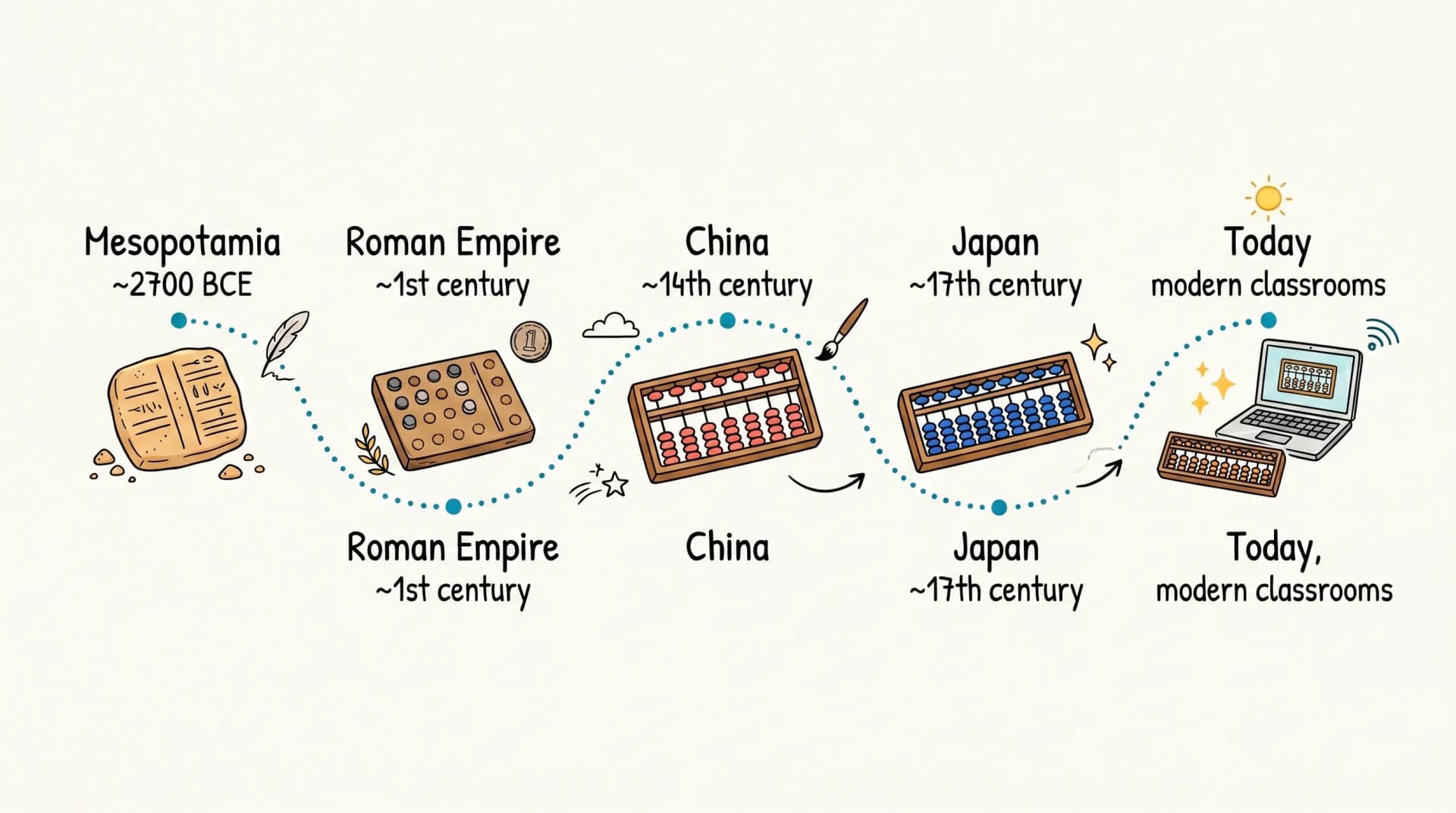
Counting boards go back roughly four thousand years, and the Salamis Tablet dates to around the fourth century BC. The bead-and-rod forms are much younger: the Chinese suanpan is documented by roughly the thirteenth century and the Japanese soroban developed from it from roughly the sixteenth century onward. The one-and-four bead form described on this page is a later standardisation: sorobans carried a fifth lower bead until roughly the 1930s.

The school counting frame
The wooden frame with ten coloured beads on each of ten rows is the one most people picture, and it is the one most often bought by mistake. It is a counting aid, not a calculating instrument.
That is not a criticism. It is genuinely useful for a four or five year old learning to count, to subitise small quantities, and to see that ten of something makes a row. But it has no place-value structure and no calculation method attached to it, and a child typically outgrows it around age six. If your child has one and enjoys it, that is a good sign about readiness, not a substitute for a soroban.
Which type of abacus should a child learn on?
The Japanese soroban. Its one-to-four bead structure gives every digit exactly one appearance, so a child learning to visualise the beads in their head is always picturing the same shape for the same number. Programmes that aim at mental arithmetic rather than bead-pushing almost universally teach on a soroban.
Practically, that means a thirteen-rod or seventeen-rod soroban with one bead above the bar and four below. If a listing shows two beads above the bar, it is a suanpan. If it shows ten beads on a row with no bar, it is a counting frame. Both are fine objects and neither is what an abacus class will ask you to bring.
Our own students train on the soroban from the first lesson, and our ten-level curriculum is built around it. There are free printable soroban worksheets if you want to try the reading and bead-setting skills before committing to anything.
Common questions
What are the main types of abacus?
The five you are most likely to meet are the Japanese soroban, the Chinese suanpan, the Russian schoty, the Roman hand abacus, and the modern school counting frame. The soroban and the suanpan are the two used for serious calculation, the schoty and the Roman abacus are largely historical, and the counting frame is an early-years counting toy rather than a calculating instrument.
What is the Chinese abacus called?
The Chinese abacus is called the suanpan, written 算盤, which translates roughly as calculating tray or reckoning board. It has two beads above the dividing bar and five below it on each rod, giving fifteen units per column.
What is the difference between the soroban and the suanpan?
The soroban has one bead above the bar and four below, so each column can show a digit from 0 to 9 in exactly one way. The suanpan has two above and five below, so several bead arrangements can represent the same digit. Both calculate decimal arithmetic perfectly well, but the soroban's single unambiguous representation is easier for a child to hold as a mental picture, which is why it became the standard teaching tool.
Which type of abacus is best for children to learn?
The Japanese soroban. Its one-to-four bead structure gives every digit exactly one appearance, so a child learning to visualise the beads in their head is always picturing the same shape for the same number. Programmes that aim at mental arithmetic rather than bead-pushing almost universally teach on a soroban.
Who invented the abacus?
No single person invented it. Counting boards appear independently in several ancient civilisations, and the oldest surviving example, the Salamis Tablet, is a marble counting board from ancient Greece. The bead-and-rod abacus that most people picture today is a later development, refined over centuries in China and then in Japan.
Was the abacus invented in India?
Ancient India had a rich tradition of counting and calculation, and it gave the world the decimal place-value system and the numeral zero, without which none of these instruments would work as they do. But the bead-and-rod abacus itself is not an Indian invention. Counting boards were in use across Mesopotamia, Greece, Rome, China and India, and the specific bead-on-rod form was developed in China and later refined in Japan. India invented the number system the abacus expresses, not the frame.
Was the abacus the first computer?
It is often called that, and school textbooks frequently say so, but the phrase is a shorthand rather than a literal fact. The abacus is a calculating aid: it stores a number and lets a person move it according to rules they have memorised. It does not compute anything by itself and has no instructions of its own. What is fair to say is that it is the oldest calculating device still in everyday use, and that the first machines that computed on their own came much later.
Is a wooden kids' abacus the same as a real abacus?
No. The wooden frame with ten coloured beads per row found in nursery classrooms is a counting aid, not a calculating instrument. It is genuinely useful for teaching a young child to count and to see quantity, but it has no place-value structure and no calculation method attached to it. Children typically outgrow it around age six.
How old is the abacus?
Counting boards go back roughly four thousand years, and the Salamis Tablet dates to around the fourth century BC. The bead-and-rod forms are much younger: the Chinese suanpan is documented by roughly the 13th century and the Japanese soroban developed from it from roughly the 16th century onward.